AI readiness assessment: a decision, not a score
An AI readiness assessment that gives a decision, not a score: 10 questions about one task, 5 outcomes in fixed order and what to do first.
A useful AI readiness assessment gives you one decision: automate this task now, prepare first, or leave it. Most free assessments give you a score from 0 to 100 and a maturity tier instead. That is nice to look at. But it does not tell a small or mid-size company what to do on Monday. Ask about one recurring task, not the whole company, and you get an answer you can act on.
Why an AI readiness score does not tell you what to do
A typical online assessment asks about strategy, data, culture and skills. At the end you get a number, a stage name and generic advice like "build a data strategy" or "train your people".
The problem is simple. A company is not ready or not ready as a whole. A task is. Your weekly report can be ready for automation while your customer inbox is not. An average of the two hides both answers.
A score also mixes small gaps with real blockers. "Steps are not written down" and "we can not check if the result is right" may cost the same points. They are not the same problem. The first takes an afternoon to fix. The second should stop the project.
And projects do die for these boring reasons. In July 2024 Gartner predicted that at least 30 % of generative AI projects would be abandoned after proof of concept by the end of 2025. The reasons it named were poor data quality, weak risk controls, rising costs and unclear business value. You can ask about all of these before the first run.
Is my company ready for AI? Ask it about one task
Where to start with AI automation: pick one task that repeats every week. Then go through this AI readiness checklist. Each question has three factual options, not a 1 to 5 feeling scale.
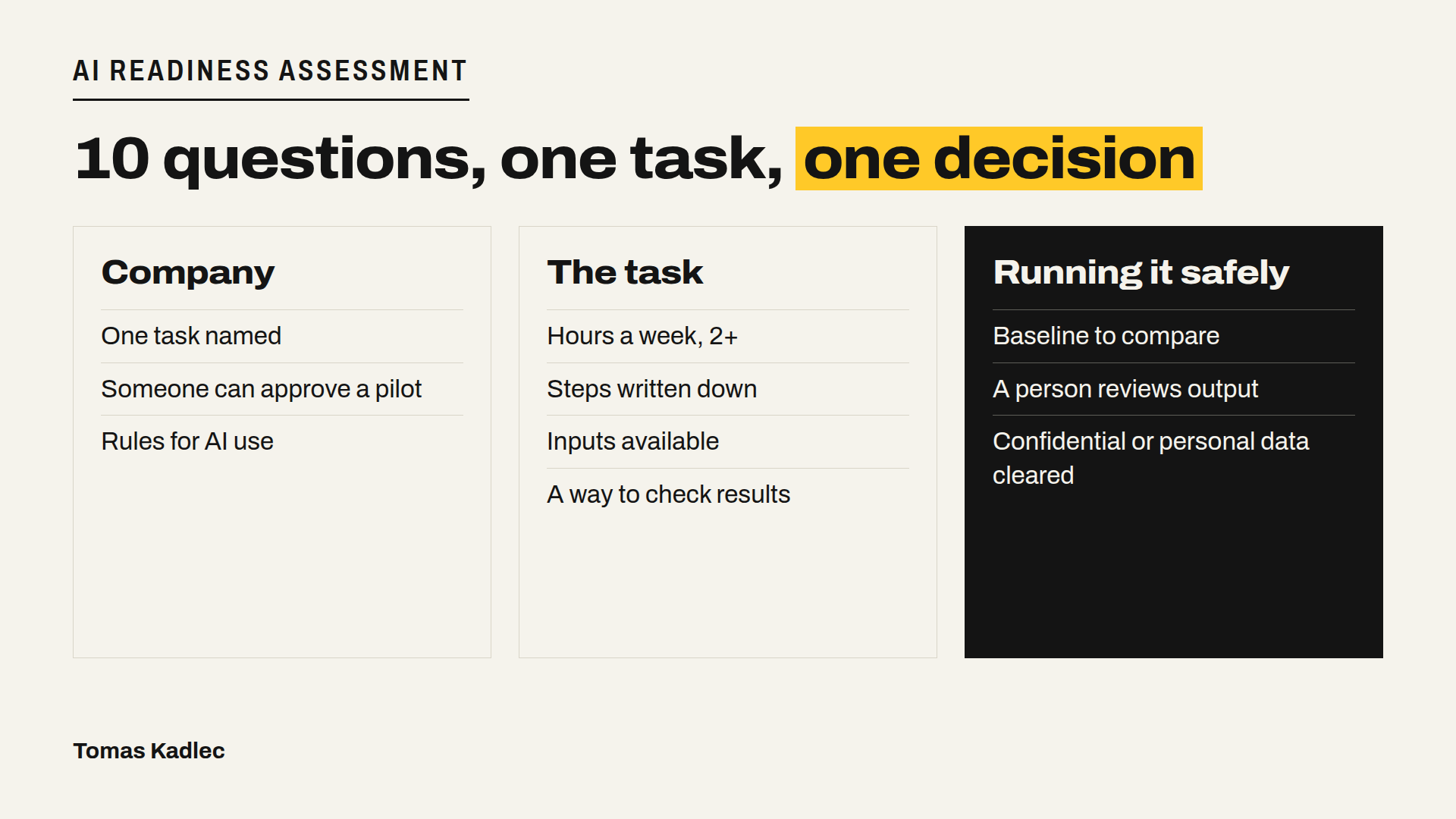
The company
- Is the task named? One concrete task, like "weekly ads report", not "use AI in marketing".
- Is there someone who can approve a pilot? A person with budget and authority to say yes to a small test.
- Are there rules for AI use? What tools people may use and what data may go into them.
The task
- How many hours a week does it take? Under 2 hours a week is the weakest answer.
- Are the steps written? Even a rough list. If the steps live only in one head, an AI agent has nothing to follow.
- Are the inputs available? Exports, files, access to the systems the task needs.
- Is there a way to check a result? A total that must match, a rule, a person who knows the right answer.
Running it safely
- Is there a baseline to compare? How long it takes today, and how good it is today.
- Is there a person who reviews the output? Someone who reads it before it goes out.
- Does the task touch confidential or personal data? And if yes, is it allowed under your rules?
The AI readiness framework: five outcomes in rule order
The rules run from top to bottom. The first rule that matches gives the outcome.
- Pick a task first. No task named. Everything else is guessing until you name one.
- Stop. A hard stop answer, see below.
- Probably not worth a build. The task takes under 2 hours a week. A good prompt in a chat tool is likely enough.
- Prepare first. No hard stop, but at least one weakest answer somewhere else. Fix that, then start.
- Go. No weakest answer anywhere. Run a pilot.
Why the hard stops are stops
Some gaps you fix in a week. Others decide if a pilot is safe at all.
- Nobody can approve a pilot. Without one person who can say yes to a small test, the pilot never starts, or it starts without anyone owning it.
- No way to check a result. If nobody can say if the output is right, you can not measure the pilot. You also can not catch errors before a client sees them.
- Confidential or personal data with no rule that allows it. Putting it into an AI tool anyway is a risk you take on for the whole company, not only for the test.
- Nobody reviews the output. An AI draft that goes out unread is how one wrong number reaches a client.
These are not "low points". They are reasons not to start yet, so the outcome says stop.
AI readiness score vs decision: why only 1.7 % reach go
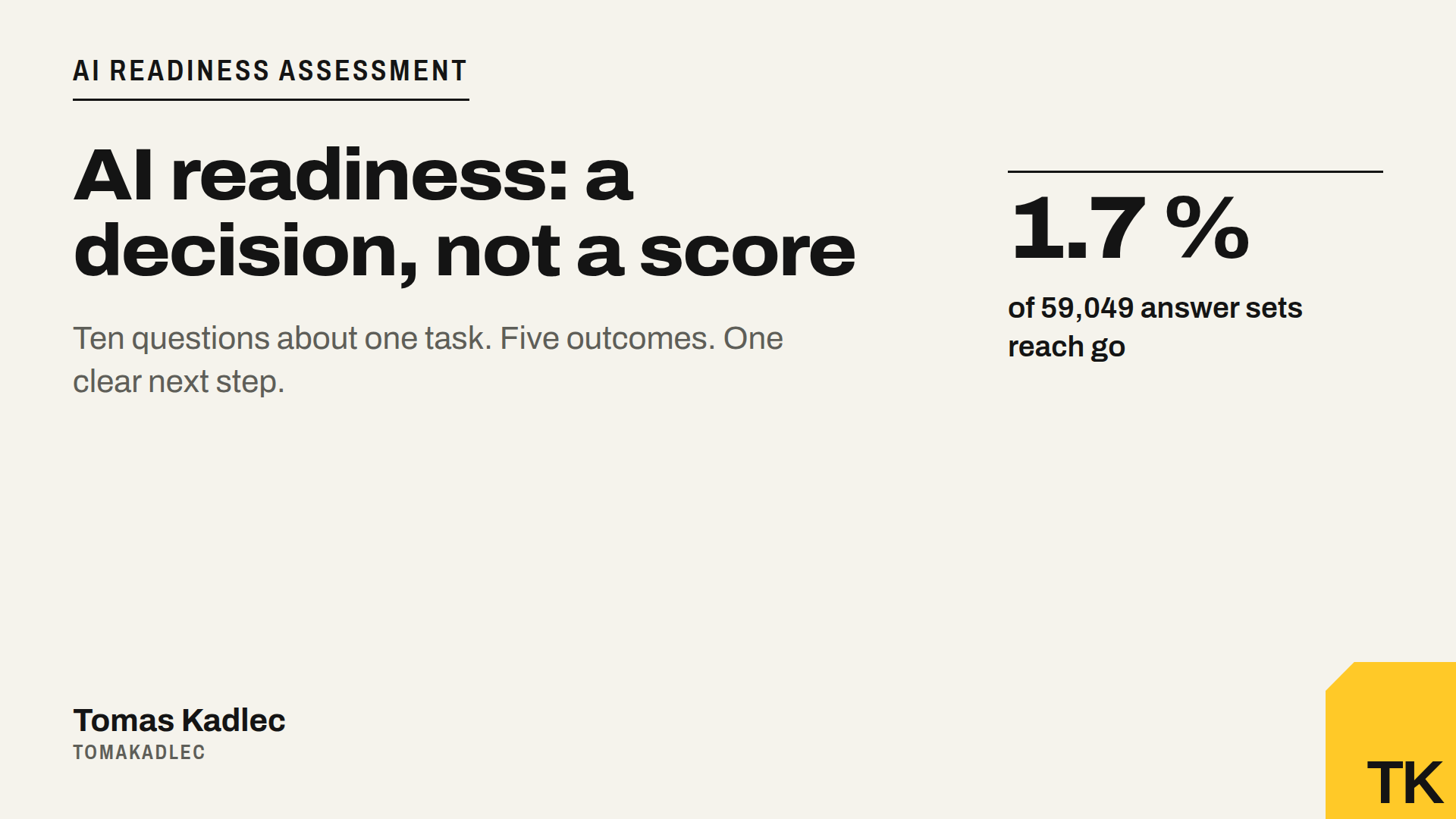
Here is the arithmetic from the rule test of my free assessment. 10 questions with 3 options each give 3^10 = 59,049 possible answer sets. To reach "go", no question can have its weakest answer. That leaves 2 options per question, so 2^10 = 1,024 answer sets. 1,024 of 59,049 is 1.7 %.
That sounds harsh. I think it is honest. The middle answers are fine. "Steps partly written" or "rules exist but informal" still reach go. You settle them before the first real run. Only the weakest answer anywhere blocks go, because each one is a gap that breaks a pilot later.
Worked example: weekly reporting
A marketing manager spends 4 hours every Monday pulling numbers from the ad platforms and the shop into one report. That is about 17 hours a month (4 × 52 / 12).
- Task named: yes, the weekly report.
- Approver: the head of marketing can approve a small test.
- AI rules: informal, nothing written yet. Middle answer.
- Hours: 4 a week, above the 2 hour line.
- Steps: partly written. Middle answer.
- Inputs: platform exports are available.
- Check: totals must match the platforms.
- Baseline: 4 hours today, known.
- Reviewer: the manager reads it before sending.
- Data: campaign totals, no personal data.
No weakest answer, so the outcome is go. Now change one thing. If the steps exist only in the manager's head, the outcome becomes prepare first. If the report took 1.5 hours a week, it becomes probably not worth a build, because rule 3 matches before rule 4 or 5.
A prompt to pick your first AI pilot project
If you are not sure which task to test, paste this into ChatGPT, Claude or another assistant:
I want to pick one recurring task for a first AI pilot project. Below this message is the list of tasks my team does every week.
For each task, ask me one question at a time to find out: hours per week, if the steps are written, if the inputs are available, how we would check a result, and if it involves confidential or personal data.
Then rank the tasks. Remove any task under 2 hours a week or with no way to check the result. Explain your ranking in plain words.
FAQ about AI readiness assessment
What is an AI readiness assessment?
It is a set of questions that tells you if you can start automating work with AI. The useful version looks at one task and ends with a decision, not a number.
Is an AI readiness score useless?
Not useless, but too general for most small companies. It can show that you lag behind. It can not tell you which task to start with or what to fix first.
What is a good first AI pilot project?
A task that repeats every week, takes more than 2 hours, has written steps and a clear way to check the result. Reporting and first drafts of answers to inquiries are common candidates.
Try it on your own task
I built a free AI readiness assessment on my site with exactly these ten questions, in English, Czech, German, French and Spanish. It has no score and no tier. The rules are shown on the page, and nothing you answer is stored. If the outcome is stop or probably not worth a build, there is no call button, because I have nothing to sell you there.
Which recurring task in your team would you test first?
Sources: Gartner, Gartner Predicts 30% of Generative AI Projects Will Be Abandoned After Proof of Concept By End of 2025, 29 July 2024 · own rule test of the AI readiness assessment on tomakadlec.com (59,049 answer sets, 1,024 reach go)