Morning Snacks: Google pre-announces a core update
Google announced its December core update before it starts. Plus ChatGPT health ads in the US, Anthropic below its IPO price and a GPT-6.2 lab test.
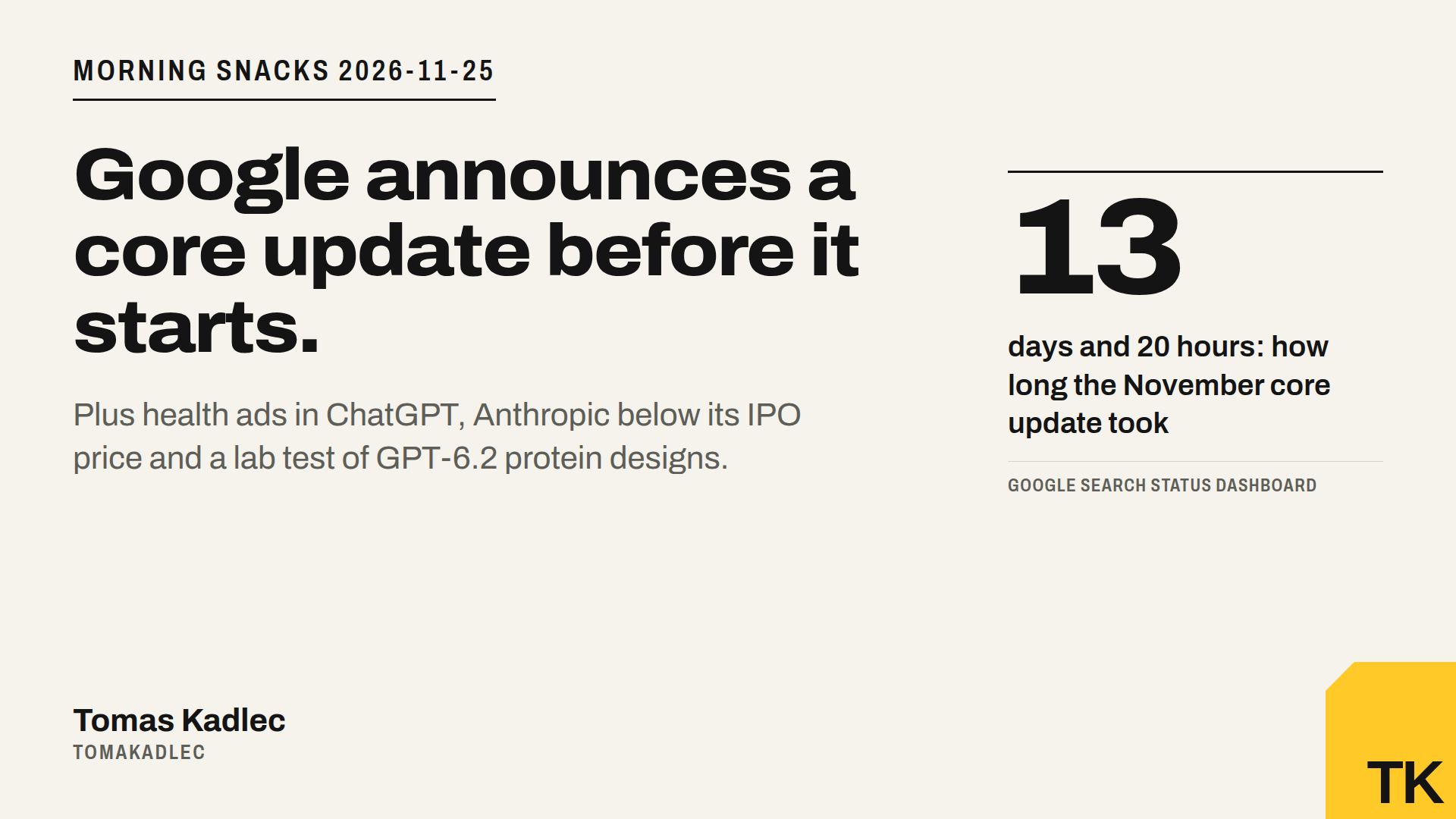
Tuesday was a search day. Google closed one core update, announced the next one, and wrote down where it will warn us from now on.
Three more items below. One of them has no marketing action at all, and I say so.
Google announces the December core update in advance
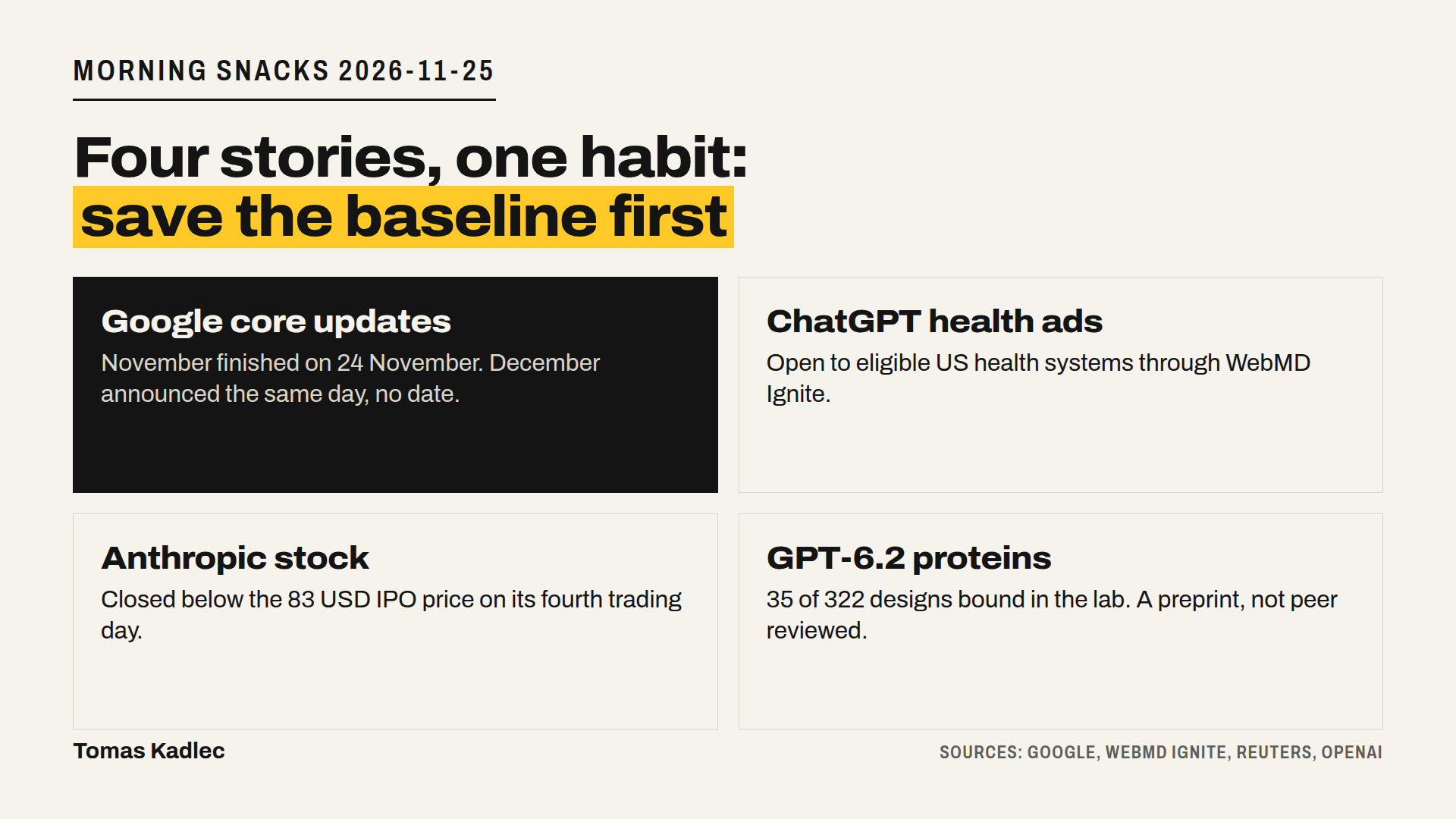
On 24 November Google's Search Status Dashboard marked the November 2026 core update as complete. It started on 10 November and took 13 days and 20 hours. About an hour later a new entry appeared: the December 2026 core update, scheduled for December, with no start date and no rollout length.
Search Engine Journal reports the scope from the entry: all locations and languages where Google Search is available. The focus is ranking relevant content, also for longer and more complex questions, and better personalised results for people who have personalisation on. PPC Land calls the advance notice a first, because Google earlier said core updates are not announced ahead.
The same day Google added a Ranking section to Search Central. One page lists its principles: users first, results treated consistently, changes tested before launch. Another page says notice of significant ranking changes, core updates included, goes on the Search Status Dashboard, which has an RSS feed. Search Engine Journal and PPC Land connect these pages to the UK CMA's fair ranking requirements, which start on 17 December. Google's entry does not say why.
So what: a core update used to be something you saw in your traffic chart afterwards. Now you get a window ahead and a known place for the notice. Do not promise what the update will do. Nobody outside Google knows. But the stated focus on long, complex questions points at the same pages AI answers pull from: pages that answer a full question well.
ChatGPT ads open for US health systems
On 24 November WebMD Ignite, the healthcare-marketing arm of WebMD, announced a ChatGPT advertising offer for eligible health systems. WebMD Ignite handles strategy, creative, optimisation and measurement. OpenAI decides who is eligible, approves the creative and delivers the ads. The release says a first cardiology campaign with an academic medical center is already running. It gives no prices, minimum spend or ad formats.
AdExchanger adds the background. Health ads were barred from the early ChatGPT ad test, the policy now gives more room in the US, and outside the US health ads stay generally prohibited. Regulated products and claims about preventing, diagnosing or treating health conditions are still out. OpenAI told AdExchanger that ads will not run where a health condition is strongly implied.
So what: ad space in AI answers opens one category and one country at a time. In health, finance or insurance the question is now which category you are, in which country, and through which partner.
Anthropic stock closes below its IPO price
On 24 November, its fourth trading day on Nasdaq, Anthropic (ANT) fell below the 83 USD IPO price, as Reuters and Bloomberg reported, and closed below it, according to CNBC. Reuters had it down 12.6 % at 76.6 USD during the day. On its first day it opened at 111.50 USD and closed at 97.17 USD. The reports describe a wider tech selloff and worries about AI valuations and infrastructure spending.
Separately, two SEC filings published on 23 November show Dario and Daniela Amodei each sold about 3.38 million shares at 83 USD on 20 November, about 280 million USD each. Reuters reports the shares went to the IPO underwriters.
So what: nothing changes in your marketing plan today, and I have no opinion on the stock. But the makers of your AI tools are now public companies, and a share price brings pressure on pricing, limits and product focus. Keep prompts, data and workflows written down so they run on a second model.
OpenAI tests GPT-6.2 protein designs in the lab
OpenAI shared a preprint with wet-lab tests run with partner Onava. 35 of 322 small binder proteins based on GPT-6.2's designs bound to their targets, a 10.9 % hit rate across five targets. Specialised tools still wrote sequences and filtered candidates, only binding was tested, and the paper is not peer reviewed.
So what: no marketing action. But this is the standard to ask from any AI vendor: a result checked outside the model, with a hit rate and a list of what was not tested.
What to do today
- Export clicks, impressions and average position by page group from Search Console, and mark 10 to 24 November as the November update. My notes on that update are here: Google's November core update: what to do now.
- Next week, compare a full week after the November update with a full week before it, for example 3 to 9 November.
- Add the Search Status Dashboard RSS feed to your team channel. In a regulated field, also read OpenAI's ad policy for your category and country, and note the date.
Search is one half of the picture. To see if AI crawlers can read the same pages, use my free AI crawler check.
Sources:
- Google Search Status Dashboard, history of ranking updates, read 25 November 2026
- Search Engine Journal, Google Announces December 2026 Core Update Ahead Of Rollout, 24 November 2026
- Search Engine Journal, Google Confirms November 2026 Core Update Is Complete, 24 November 2026
- Search Engine Journal, Google Documents Advance Notice For Significant Ranking Updates, 24 November 2026
- PPC Land, Google preannounces a December core update as AI Overview links slide down, 25 November 2026
- WebMD Ignite via Yahoo Finance, WebMD Ignite Brings ChatGPT Advertising to Health Systems, 24 November 2026
- AdExchanger, Healthcare Ads Are Coming To ChatGPT, 24 November 2026
- Reuters via Investing.com, Anthropic shares tumble below 83 USD IPO price, 24 November 2026
- TheStreet via Yahoo Finance, Anthropic stock falls below IPO price, 24 November 2026
- CNBC, Anthropic closes below 83 USD IPO price, 24 November 2026
- Bloomberg, Anthropic Shares Fall Below 83 USD IPO Price in Fourth Trading Day, 24 November 2026
- Let's Data Science, OpenAI Reports GPT-6 Models Can Design Proteins With Lab Evidence of Binding, 24 November 2026
- Glitchwire, OpenAI Says GPT-6 Designed Proteins That Bound to Lab Targets, 24 November 2026