84% of AI citations are not your website
More than 84% of AI citations come from third-party pages, not brand sites. How to find the pages AI cites in your category and get on them, every week.
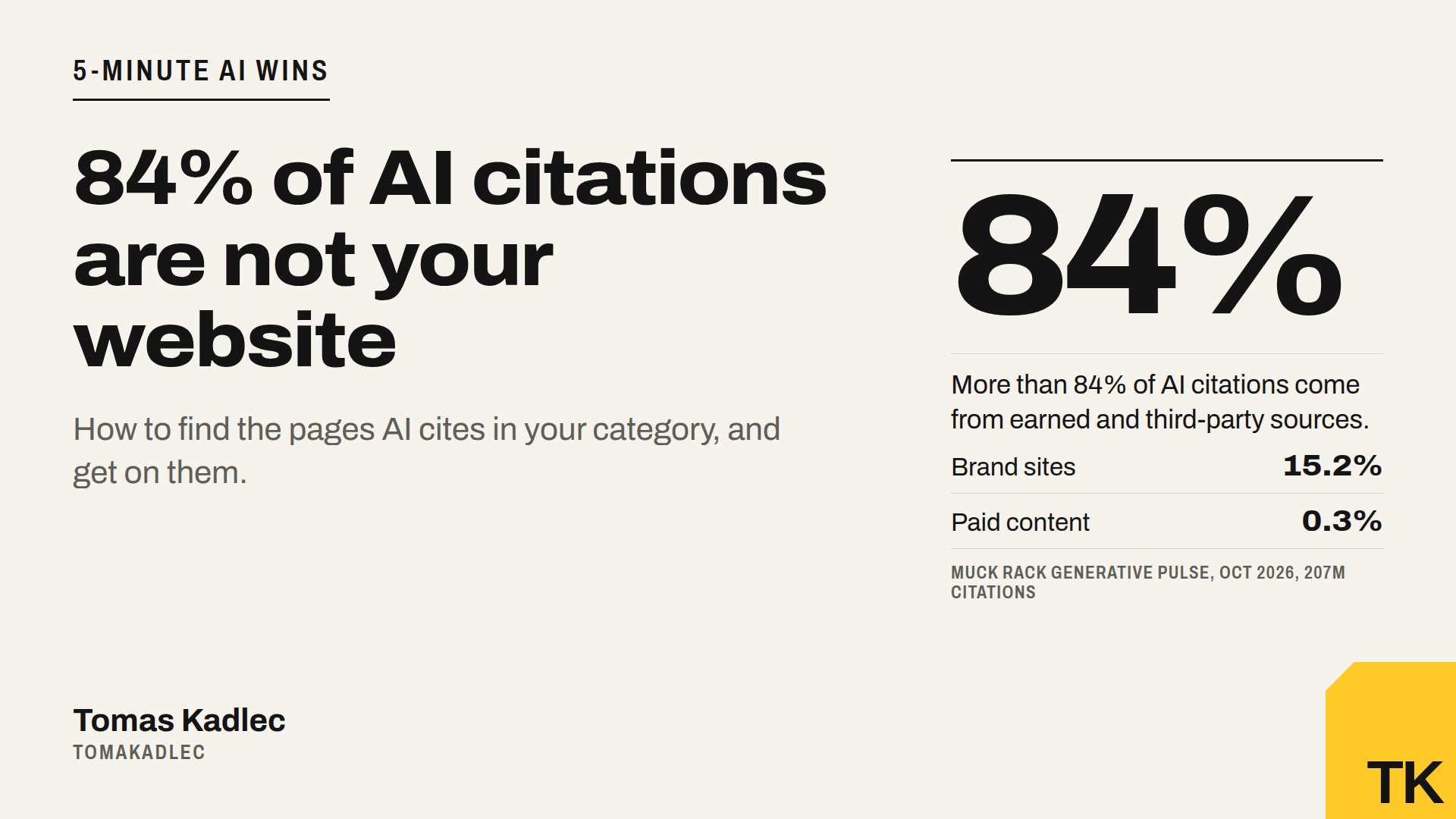
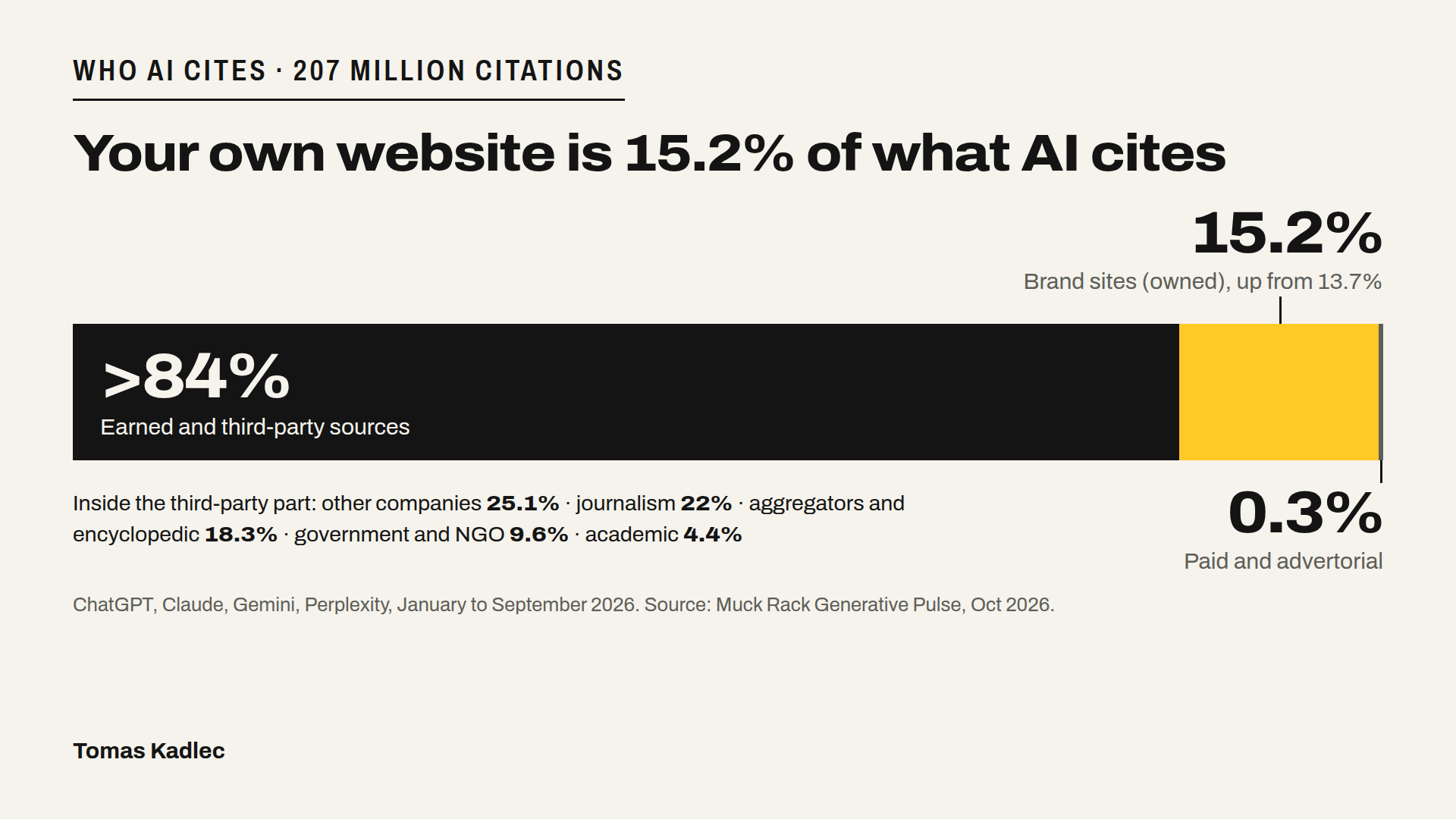
Muck Rack checked 207 million citations in more than 40 million AI answers from ChatGPT, Claude, Gemini and Perplexity, January to September 2026. More than 84% of the citations came from earned and third-party sources. Brand websites got 15.2%. Paid content got 0.3%.
So when an AI answers a question about your category, it mostly quotes other people's pages. Pages about you, or about your competitors. Your own site is the small part.
I see this in my own numbers. I measured my brand in 60 AI answers: 0 mentions, my site cited 0 times. Better content on my own site alone will not fix that. So now I work on a placement plan for the third-party pages AI cites in my category.
What the data says
- Earned and third-party sources: more than 84% of citations. In all four editions of the report it stayed between 82 and 89%.
- Owned brand sites: up from 13.7% to 15.2%. Growing, but small.
- Paid and advertorial content: 0.3%. You can not buy your way into the answer.
- Journalism: down from 27% in May to 22%. Third-party corporate content went up to 25.1%, aggregators and encyclopedic sites to 18.3%.
- Only 212 domains were cited by all four AI providers. Each assistant has its own source map.
The last point matters most for a small company. There is no single list of "AI sources". You have to find the pages for your category, in the assistants your buyers use.
How to find the pages AI cites in your category
- Write 20 to 30 buyer prompts. Questions a buyer asks before they know you. No brand names. An example for an accounting software: "best invoicing tool for freelancers in Germany" or "how to switch from Excel invoices".
- Run them in the assistants your buyers use. ChatGPT, Gemini, Perplexity, Claude. Fresh chat, search on.
- Log every cited URL. One row per citation: prompt, assistant, URL, date.
- Group the domains. Lists and comparisons, directories, media, forums, partner blogs. Plus competitor sites.
- Mark what you can reach. A comparison list can add you. A directory listing you can create or fix. A forum thread you can answer honestly. A partner can write about a project you did together. Big media is slower.
- Start small. Pick the 3 to 5 most cited domains that you can reach. Not 50.
Here is the prompt I use for steps 4 and 5:
I attach a table of URLs that AI assistants cited for buyer questions in my category, with the prompt and the assistant for each row. Group the URLs by domain and count the citations per domain. Give each domain one type: list or comparison, directory, media, forum, partner or industry blog, competitor site, other. Then say for each domain what a small company could realistically do to appear there (be added to a list, create or fix a listing, answer a thread, co-write a post), or say "not reachable". Use only the data I give you, do not guess numbers. Return one table sorted by citation count.
Re-check every week
AI citations move. In the report, the same prompt run twice on the same day gave different sources. ChatGPT repeated only 41% of its cited domains. Gemini 45%. Perplexity repeated 94%.
So one check is a snapshot, not a map. Run the same prompts once a week, in the same assistants, and compare with last week. Which domains are new? Which disappeared? Does your brand show up on any of them? A domain that comes back week after week is worth more work than one that showed up once.
Keep the prompts the same. If you change them every week, you can not compare.
Do not forget your own crawler settings
Third-party pages are the bigger part, but your own 15.2% still counts. The report found that 81% of major publishers that block Claude's search crawler got almost no Claude citations. Of the publishers that allow it, only 12% had that problem. If your site blocks AI crawlers, you lose even the small part you could get.
Summary
More than 84% of what AI cites is not your own site. Find the third-party pages AI cites for your category with 20 to 30 buyer prompts, group them, and start with the ones you can reach. Re-run the same prompts every week, because the sources change. And check that AI crawlers can read your site.
Start with the free AI crawler check, it shows in a minute if known AI crawlers can read your site. If you want the full source map for your category, with buyer prompts in your languages and the pages you can reach, that is the AI-visibility audit. Or book a free 20-minute call.
Which third-party page do you think AI cites most in your category?
Sources: Muck Rack via GlobeNewswire (The Manila Times), Generative Pulse: earned media still drives more than 84% of AI citations, 28 October 2026 · Muck Rack via GlobeNewswire, Generative Pulse: earned media consistently drives AI citations, holding at 84%, 7 May 2026 · Tomas Kadlec, My brand showed up in 0 of 60 AI answers, 18 November 2026