An AI avatar trashes your brand. Who do you sue?
A generated influencer on Instagram says your product is bad. Who is liable, which law applies and why suing is often the wrong first move.
Imagine this. A friendly face on Instagram, 80,000 followers, posts a short video: "I tried brand X. Total waste of money, it broke after two days." The comments go wild. Your sales team gets questions.
Then you find out the face does not exist. It is a generated avatar. Nobody knows who runs the account.
Who do you sue? The avatar? Instagram? The AI company that made the video?
I am not a lawyer, so I took this question to people who are. A lot of what follows comes from talks and interviews by Petra Stupková, founder of the Prague law firm Legitas and co-founder of the Czech AI Association, plus the EU rules that now apply. Below is how I would think about it as a marketer.
The avatar is never the defendant
An AI character has no legal personality. It cannot owe you money or say sorry. Behind every avatar there is a person or a company that runs it, pays for it and publishes the content.
Stupková put it clearly at AI Restart 2026 in Prague: the operator of a virtual influencer carries full legal, consumer and ethical responsibility for what the character says. "The AI said it" is not a defence. It is the same as "my intern posted it".
So the real question is not "who is liable". It is "can I find the operator, and can I reach them".
Three cases, three very different chances
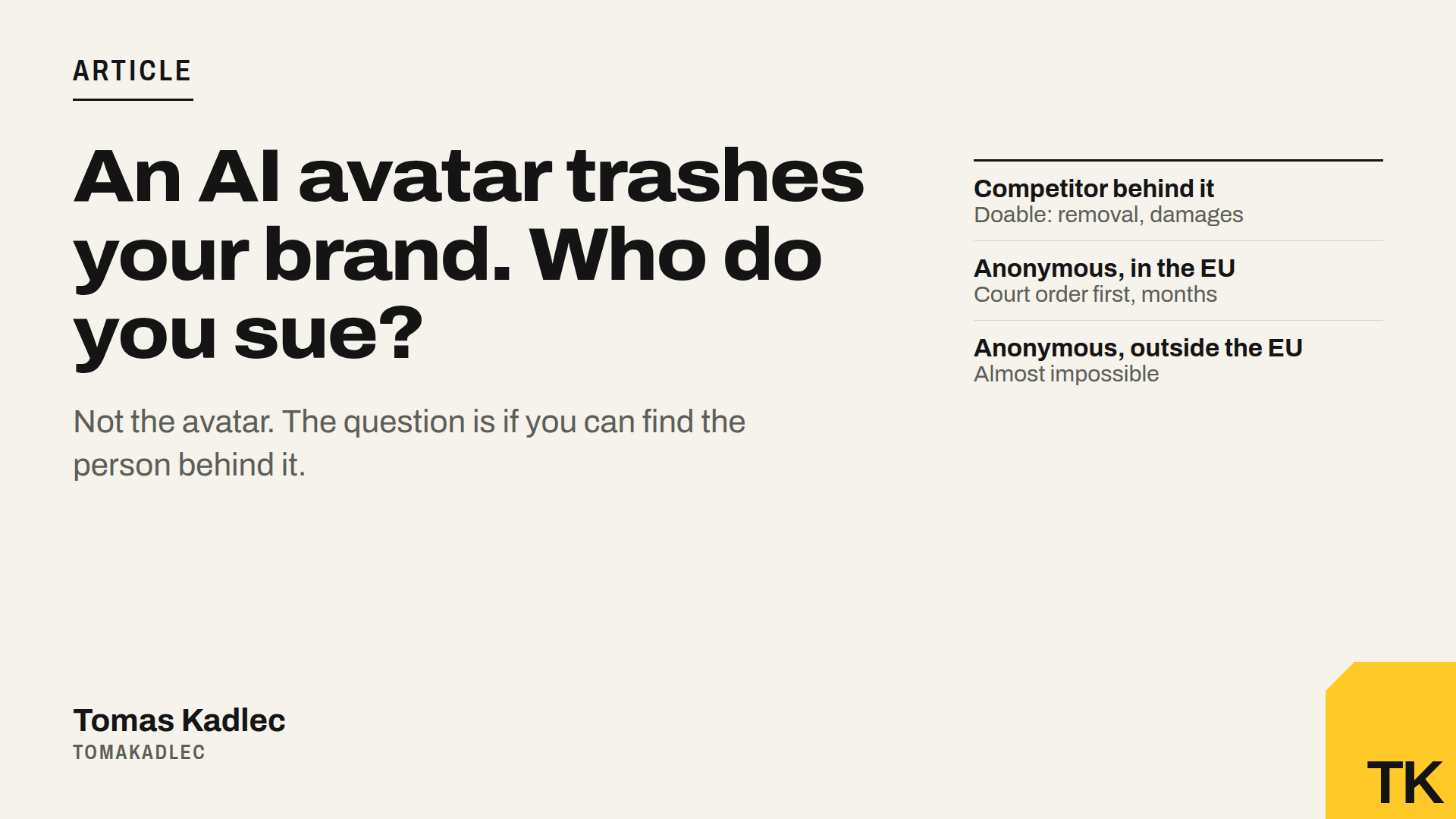
Case 1: a competitor or an agency runs the avatar. This is the good case. In Czech law, false or misleading statements about a competitor's products are disparagement (zlehčování, § 2981 of the Civil Code) and unfair competition in general (§ 2976). A company also has the right to protect its reputation (§ 135). You can ask for the content to be removed, an apology and damages. Under EU rules a company can usually sue in the country where its business is centred, for the whole damage, even when the post was made from somewhere else (EU Court of Justice, Bolagsupplysningen, C-194/16, 2017).
Case 2: an anonymous operator inside the EU. Harder, but not hopeless. You need the platform to tell you who it is, which usually means a court order or a police request. That takes months. The post is viral in hours.
Case 3: an anonymous operator outside the EU. Honestly, almost impossible. Even if you win, there is nobody to enforce the judgment against. Here the law is not your main tool. The platform is.
What the platform must do
The EU Digital Services Act gives you a fast track that does not need a court. Instagram, TikTok and the others must run a notice and action system: you report illegal content, explain why, and the platform must decide and tell you the result.
Since 2 August 2026 there is a second hook. Article 50 of the EU AI Act says that deployers must label deepfakes: realistic AI-generated images, audio or video. The Commission's guidance counts realistic AI avatars and personas too. An unlabelled fake person attacking a real brand is now a clearer case to report.
Can you at least protect your own avatar?
Many brands now want their own AI face. Here is the catch Stupková keeps repeating: purely generated content has no copyright protection, because copyright needs a human author. If somebody copies your AI mascot, you may have nothing to stand on.
Her practical advice: register the character as a trademark. That is often the only real protection you get. And if your own avatar talks about competitors, you are now the operator in Case 1. Everything above applies to you.
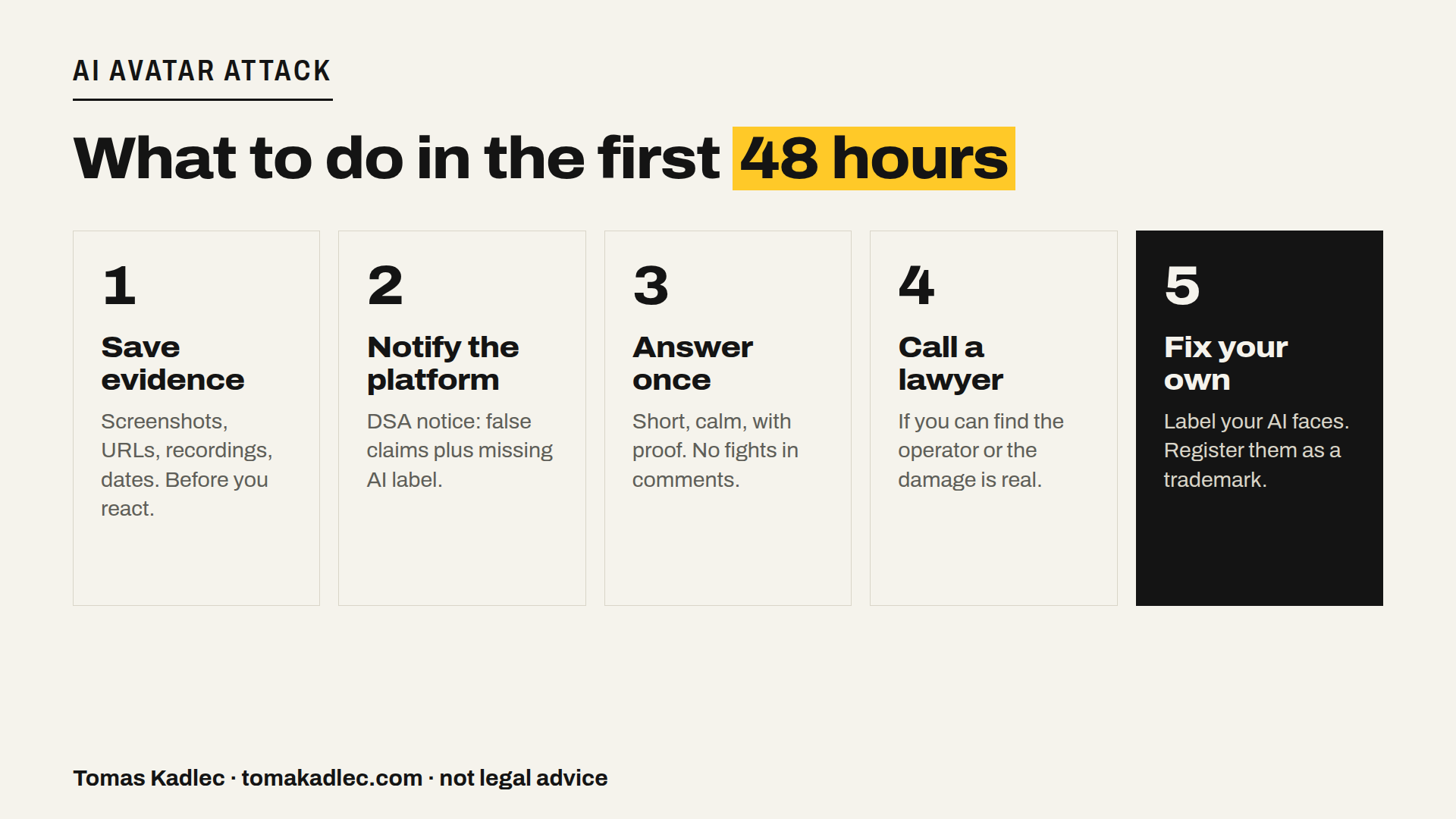
What I would do in the first 48 hours
- Save evidence. Screenshots with date and URL, a screen recording, the account handle, follower count, comments. Do it before you react, posts disappear.
- Report it to the platform as a DSA notice: false statements about your company plus a missing AI label. Be specific, link every post.
- Answer facts in public, once. Short, calm, with proof. Don't argue with the avatar in the comments.
- Call a lawyer if you can identify the operator or the damage is real. Ask about disparagement, a removal order and what it costs.
- Fix your own house. If you use AI characters, label them, keep a record of who approves their posts and register what you want to protect.
Summary
The avatar is a puppet. Liability sits with the hand inside it. When you can see the hand, the law works. When you can't, your best tools are evidence, a fast platform notice and your own clear answer. And if you build your own AI face, register it and label it before somebody else tests the rules on you.
Has a fake account ever attacked your brand? What worked for you?
This is not legal advice. For your case talk to a lawyer who works on AI and brand law. If you want help with the marketing side of AI, book a free 20-minute call on tomakadlec.com.
Sources: AI Restart 2026 report, Digichef, 30 October 2026 · "Právní rizika AI v e-commerce s Petrou Stupkovou", Včeliště podcast · Czech Civil Code §§ 135, 2976, 2981 · CJEU C-194/16 Bolagsupplysningen, 17 October 2017 · Digital Services Act, Regulation (EU) 2022/2065, Article 16 · EU AI Act, Regulation (EU) 2024/1689, Article 50 (applies from 2 August 2026, not delayed by the Digital Omnibus).