Your AI citations change 40% a week. That is normal
In an average week, the share of citations in ChatGPT answers moved by 39%. In Gemini by 41%.
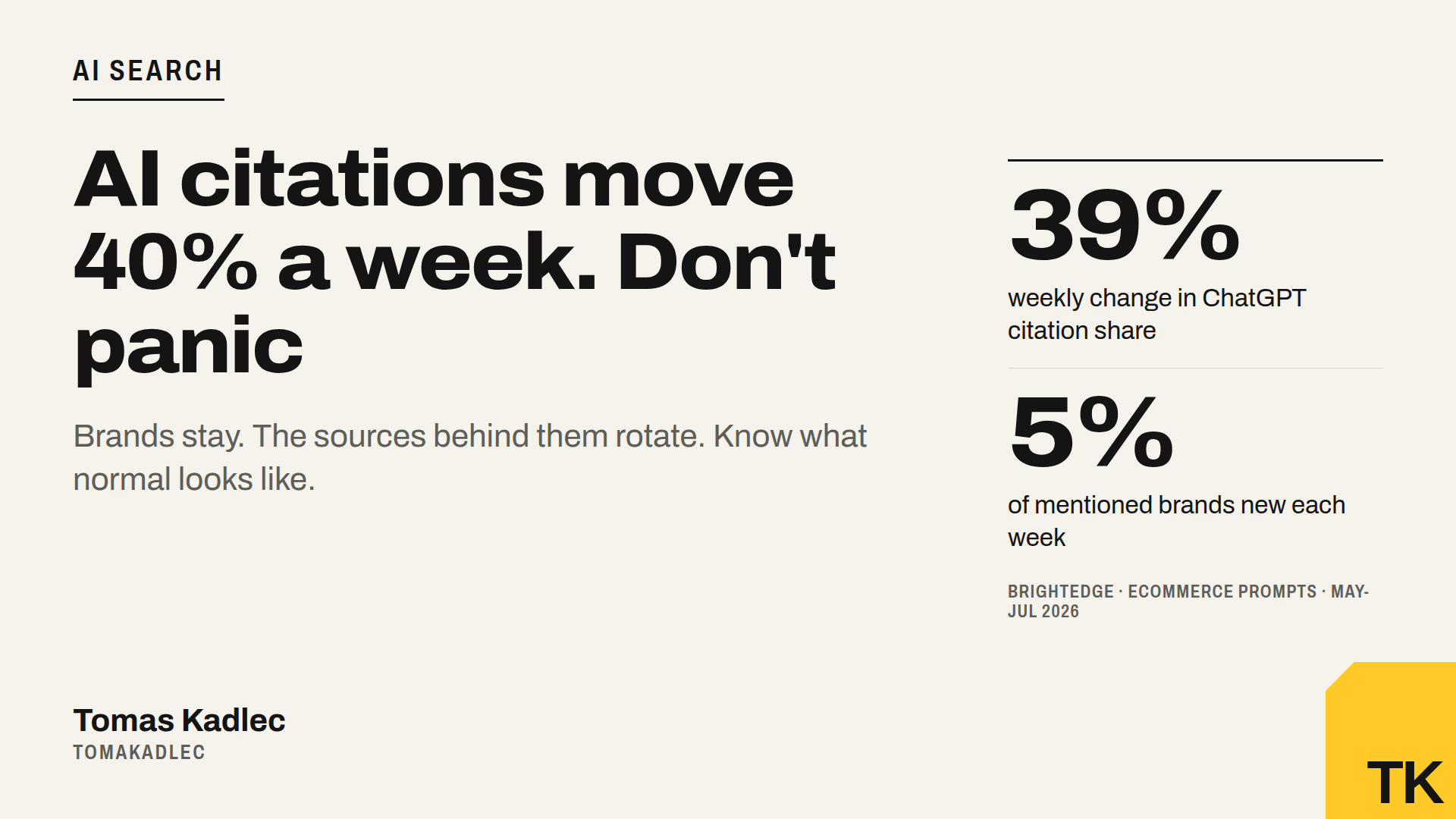
In an average week, the share of citations in ChatGPT answers moved by 39%. In Gemini by 41%.
That is from BrightEdge. They tracked ecommerce and shopping prompts in ChatGPT, Gemini and Google AI Overviews every week for 12 weeks, from May to July 2026.
Now the interesting part. The brands did not move much. Only 5% of the brands ChatGPT mentioned in a week were new compared to the week before. In Gemini only 3%.
So the brands stay. The evidence behind them rotates.
My take: if somebody reports "we lost 30% of our AI citations this week", maybe nothing happened. You need to know what normal looks like before you react.
Brands are stable, sources are not
Here are the weekly numbers from the study:
| Every week, on average | ChatGPT | Gemini |
|---|---|---|
| Mentioned brands that are new | 5% | 3% |
| Cited URLs that are new | 15% | 37% |
| Change in share of mentions | 25% | 25% |
| Change in share of citations | 39% | 41% |
The AI keeps recommending roughly the same brands. But it keeps changing which pages it uses as proof.
Google AI Overviews show it best. Between 17 May and 26 July, YouTube went from about 31% to about 65% of AI Overview citations in this data. Reddit dropped from 28% to 17%, Amazon from 24% to 19%. The sites did not change. The engine changed what it likes to cite.
And concentration is very different per engine. The top 5 domains hold 41% of all AI Overview citations, but only 12% in Gemini and 11% in ChatGPT. One strategy will not fit all three.
How to read your AI visibility numbers: 4 rules
1. Track mentions and citations as two numbers.
A mention means the AI names your brand. A citation means it links your page as a source. One combined "AI score" mixes a stable number with a noisy one, and you learn nothing.
2. Set a baseline before a target.
Measure 4 weeks before you promise anything. In this data, around 40% weekly movement in citations was the normal state, not a finding. Your category can be different, so measure your own.
3. A mention drop is the alarm.
Losing mentions is rare. If your share of mentions falls 2 weeks in a row, investigate: new competitor, bad reviews, a page that changed, a feed problem.
4. Ask "only me, or everybody?"
If the whole category moves in the same week, it is the engine. If only your brand moves and it stays like that for 2 or more weeks, it is you.
Check weekly. A monthly report only shows you the net result and hides what happened.
The one thing you fully control: your product data
BrightEdge has one line I really like about Google product cards: "Unpopulated fields are not neutral. They are delegated."
If you leave an attribute empty in your product feed, the engine fills it from somewhere else. A review site, a marketplace, a forum. Somebody else writes your product card.
So this week:
- open your Merchant Center feed and fill every attribute you can (material, size, colour, use case, GTIN)
- keep price and availability exact, every day
- since this week ChatGPT also accepts product feeds with price and availability, through its new Business Hub (still beta)
Your feed does not rotate like citations. It changes only when you change it.
Short summary
AI engines keep the same brands but rotate the sources a lot. Around 40% weekly change in citations was normal in this ecommerce data. Track mentions and citations apart, measure a 4-week baseline, react to mention drops, and fill your product feed so nobody else fills it for you.
If you want help to set up weekly AI visibility tracking for your brand, book a free 20-min call. Book it on tomakadlec.com.
What do you report today: mentions, citations, or one mixed score?
Sources: BrightEdge, "Brands Hold, Evidence Turns Over: 12 Weeks of Ecommerce Citations Across Three AI Engines", 30 July 2026 (vendor study) · Reuters via The Star, 11 November 2026.