AI client presentations: 106 hours a month saved
A team of 4 copied data into client slides. Now AI drafts them and 2 people check. The numbers, and the 4 that got the CEO's yes.
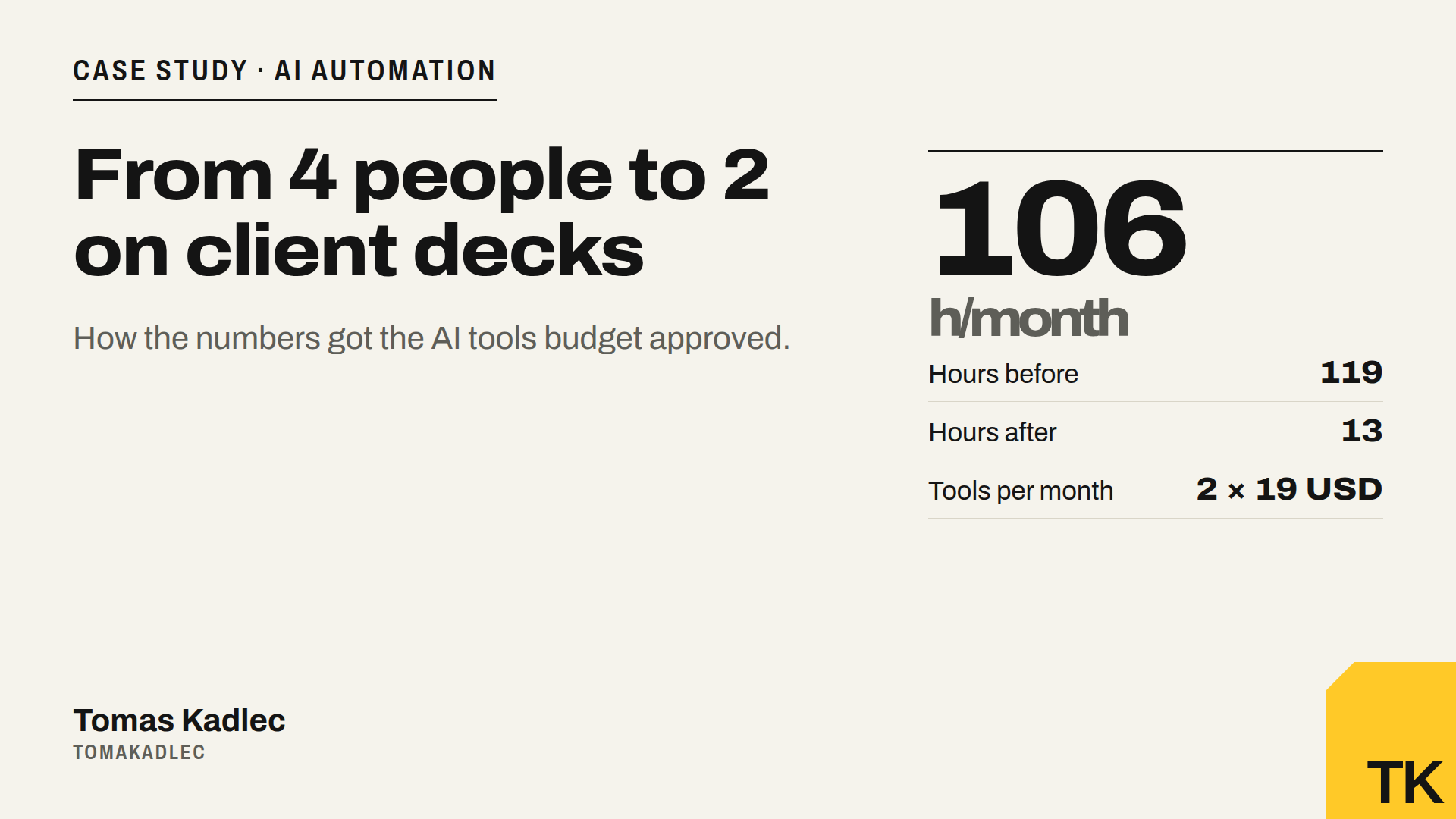
A team of 4 people spent about 28 hours a week copying data from a database into client presentations. Now 2 people check AI drafts, about 1-2 hours a week each. The tools cost 2 subscriptions at 19 USD a month.
The automation was not the hard part. The approval was. The CEO finally approved the budget for the AI tools the team needed, after the Head of IT and the CFO saw the numbers.
This is the case with the numbers we used. The company stays anonymous. At the end I added two made-up examples for comparison: one that pays off only if checking stays short, and one that never pays.
The situation
The team builds presentations for clients. The work is mostly the same every time: open the database, copy the numbers, paste them into slides, fix the format.
Every person did about 7 hours of this a week. With 4 people that is 28 hours a week, about 119 hours a month. The clients need the presentations, so nobody could just stop doing it.
What we automated
The presentation is now drafted automatically. The data comes in through MCP, a connector from the AI tool to the database. The AI reads the numbers directly. Nobody copies them by hand anymore.
What stays human: a quick check of the draft, and approving the e-mail draft with the presentation attached.
Cost: 2 subscriptions at 19 USD a month. Together 38 USD, about 35 EUR.
2 people still do the check. The other 2 are free from this task completely. Their hours are free for other work.
The numbers before and after
I put the case into my AI automation ROI calculator. Some inputs are facts from the team, some are my assumptions:
- Facts: team size, hours by hand, the work that stays after automation, 35 EUR a month for the tools.
- Assumptions: hourly cost 30 EUR (full cost to the company), 75 % of saved time turns into money because the freed people do other paid work, build cost 600 EUR (about 20 hours of setup), 1 month of ramp-up.
| Before | After | |
|---|---|---|
| Hours a month | about 119 | about 13 |
| Labour cost a month | 3,570 EUR | 383 EUR |
| AI tools a month | none | 35 EUR |
| People on the task | 4 | 2 (checking only) |
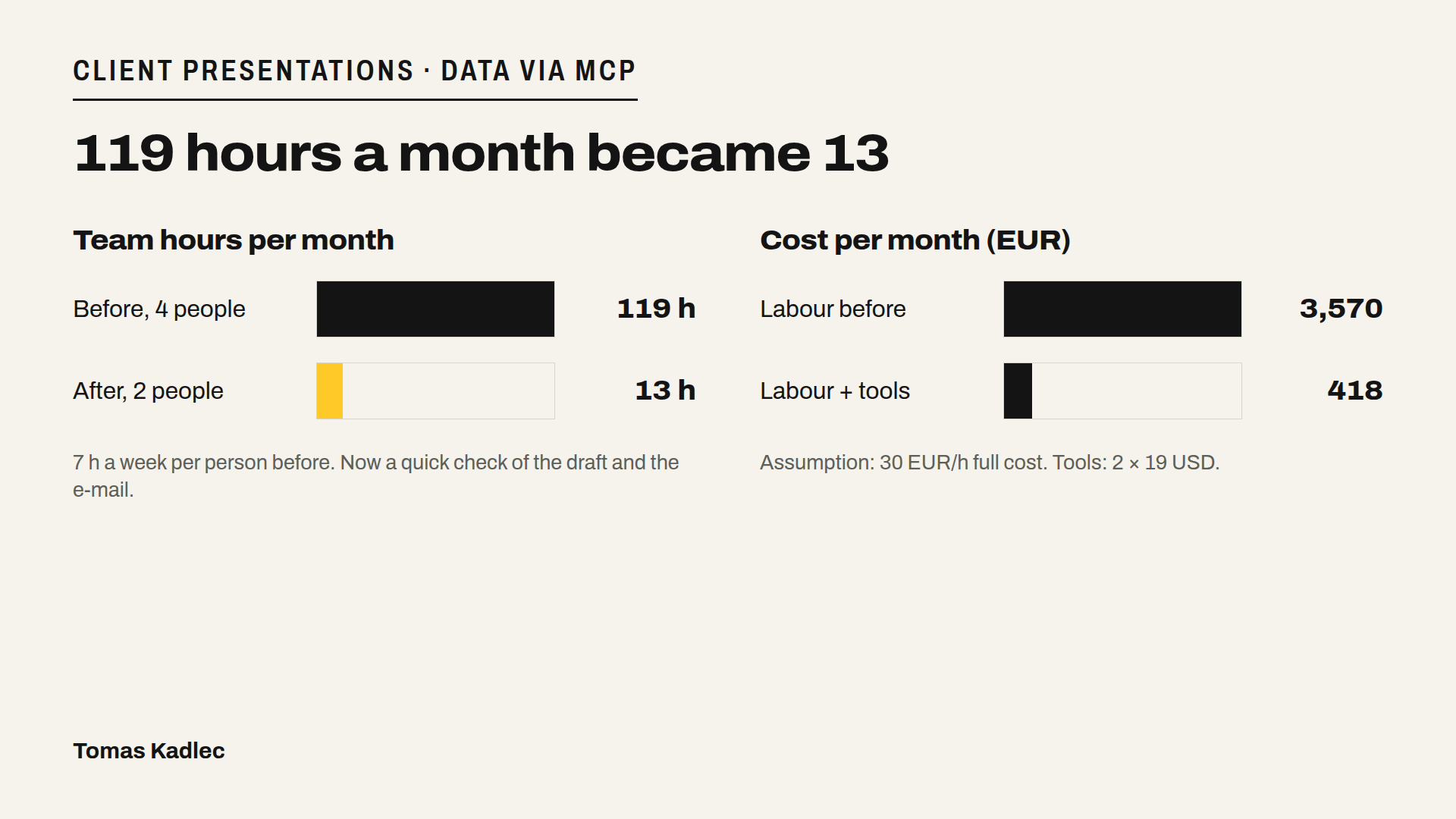
That is about 106 hours a month saved, 89 % of the work. After the 35 EUR for tools the net benefit is about 2,356 EUR a month. Payback is about 2 weeks. Net after 12 months is about 26,500 EUR. Verdict of the calculator: pays off clearly.
How we presented it to Head of IT, CFO and CEO
We did not send a demo. We sent 4 numbers:
- Hours before and after. About 119 hours a month to about 13.
- Cost per month. 35 EUR for tools, against labour going from 3,570 EUR to 383 EUR.
- Payback. About 2 weeks.
- The worst case. In the pessimistic scenario it still pays off: payback about 1.1 months, net after 12 months about 20,900 EUR.
The fourth number did the most work. An expected case is a promise. A pessimistic case that still pays off is a decision.
Result
The CEO approved the budget for the AI tools. 2 people are free from the task. The 2 who stayed spend about 1-2 hours a week on checks instead of 7.
The lesson: the money was never the problem. It was 35 EUR a month. The approval came because the numbers were in the language of the CFO: hours, cost per month, payback, worst case.
A good and a bad case for comparison
Not every automation looks like this. These two are made-up examples, not clients. I use them to show where a case breaks.
Example 1, made up: product descriptions
Say you run an e-shop and AI drafts 80 product descriptions a month. By hand one takes 20 minutes. Hourly cost 35 EUR, 50 % of saved time turns into money, build 1,500 EUR, AI usage 20 EUR and other costs 40 EUR a month, 2 months ramp-up.
- Checking takes 8 minutes: pays off. Payback about 8 months, about +860 EUR after 12 months, about +6,140 EUR after 36.
- Checking takes 11 minutes: borderline. Payback about 11 months, and the pessimistic case loses about 2,130 EUR over 36 months.
- Checking takes 16 minutes: does not pay off. Payback about 48 months, and after 36 months you are still about 390 EUR down.
3 minutes of checking per item decide the business case. Measure checking time before you sign anything.
Example 2, made up: sales call summaries
An example team has 20 calls a month. Notes take 15 minutes by hand, 10 minutes after (reading and fixing the AI summary). Hourly cost 40 EUR, only 25 % of saved time turns into money, build 3,000 EUR, AI 30 EUR and other costs 60 EUR a month.
The benefit is about 17 EUR a month. Running costs are 90 EUR. It never pays back. To flip it you would need to save about 111 minutes per call, on a 15-minute task. Impossible.
Small volume, small saving per run, and time that does not turn into money: no case, however good the tool looks.
Checklist before you ask for budget
- Hours by hand per month, measured, not guessed.
- Human minutes per run after automation, checking included.
- Share of saved time that really turns into money.
- All running costs per month.
- Payback in the pessimistic case.
Summary
A team of 4 spent about 119 hours a month on client presentations. With AI drafts and data through MCP, 2 people now check them in about 13 hours a month, for 35 EUR of tools. The CEO approved the budget because the numbers answered the CFO's questions, the worst case included. Run your own case before you pitch it. Some tasks pay back in weeks, some never.
Put your own task into the free AI automation ROI calculator. It shows the payback month, three scenarios and where the result flips, no sign-up.
Which recurring task in your team would you put in the calculator first?
Sources: Tomas Kadlec, AI automation ROI calculator and its method, November 2026. Case facts stated by the team, November 2026, company anonymous. Hourly cost, share of time that turns into money, build cost and ramp-up are my assumptions, as marked in the text.