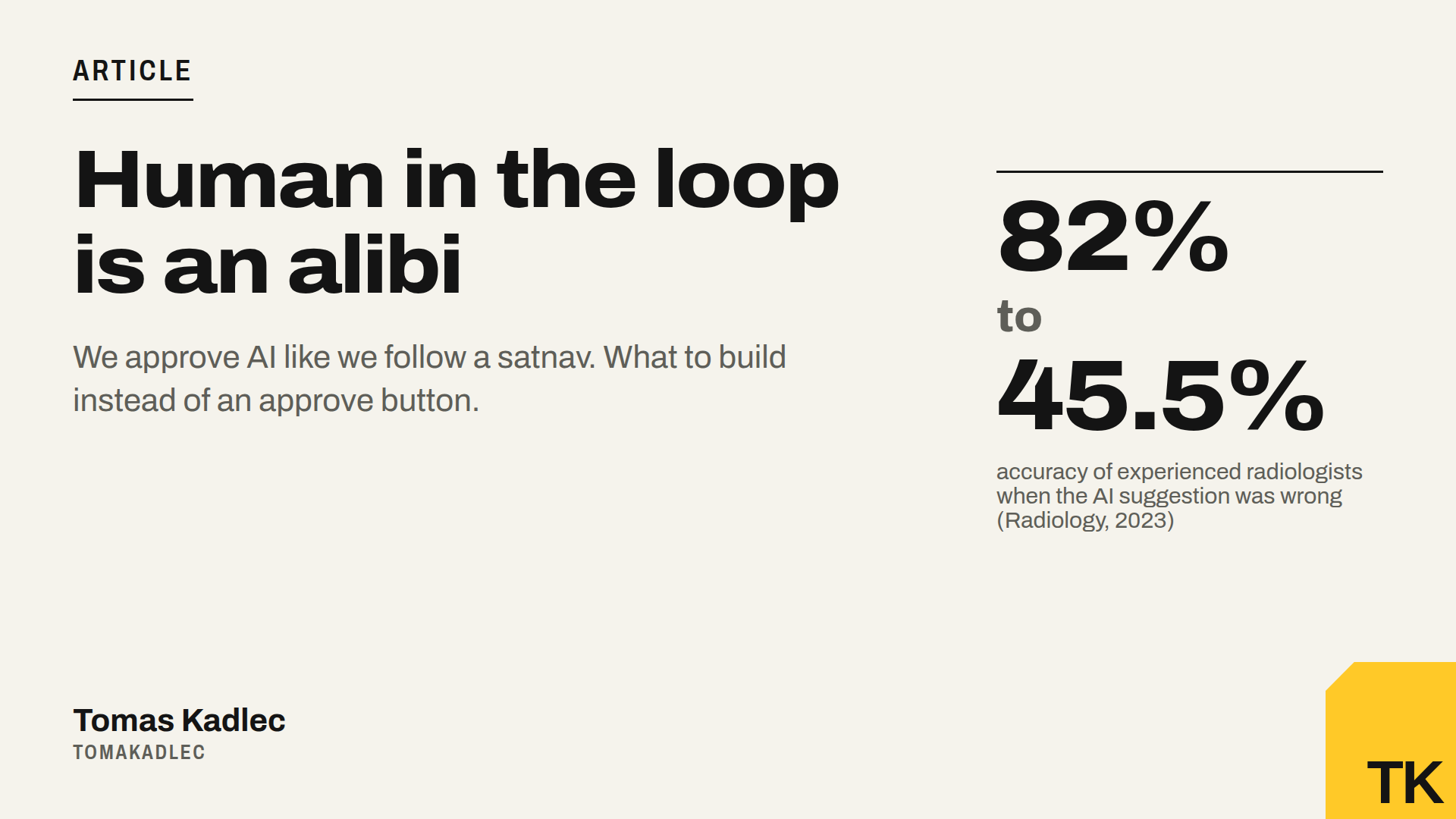
Human in the loop is an alibi, not a control
People approve AI the way they follow a satnav. Studies show reviewers stop checking. What to build instead of an approve button.
When did you last question your satnav?
You drive to a city you don't know. The voice says "turn left in 300 metres". You turn left. You don't check the map, you don't ask why. After a few months you can't drive there without the phone. That is not laziness. That is how the brain saves energy.
Now look at how most companies "control" AI. The answer is almost always the same: a human approves the output. Human in the loop. It sounds safe. In practice it is the satnav again.
The approve button trains people to approve
I run my own brand with AI agents. On a normal weekday they prepare around 30 things that go out under my name: posts, articles, connection invites, replies. I am the human in the loop. And I can tell you honestly what happens after the first week. When 29 of 30 drafts are fine, you stop reading the 30th properly. You scan, you click, you move on.
Research says the same, only with better numbers.
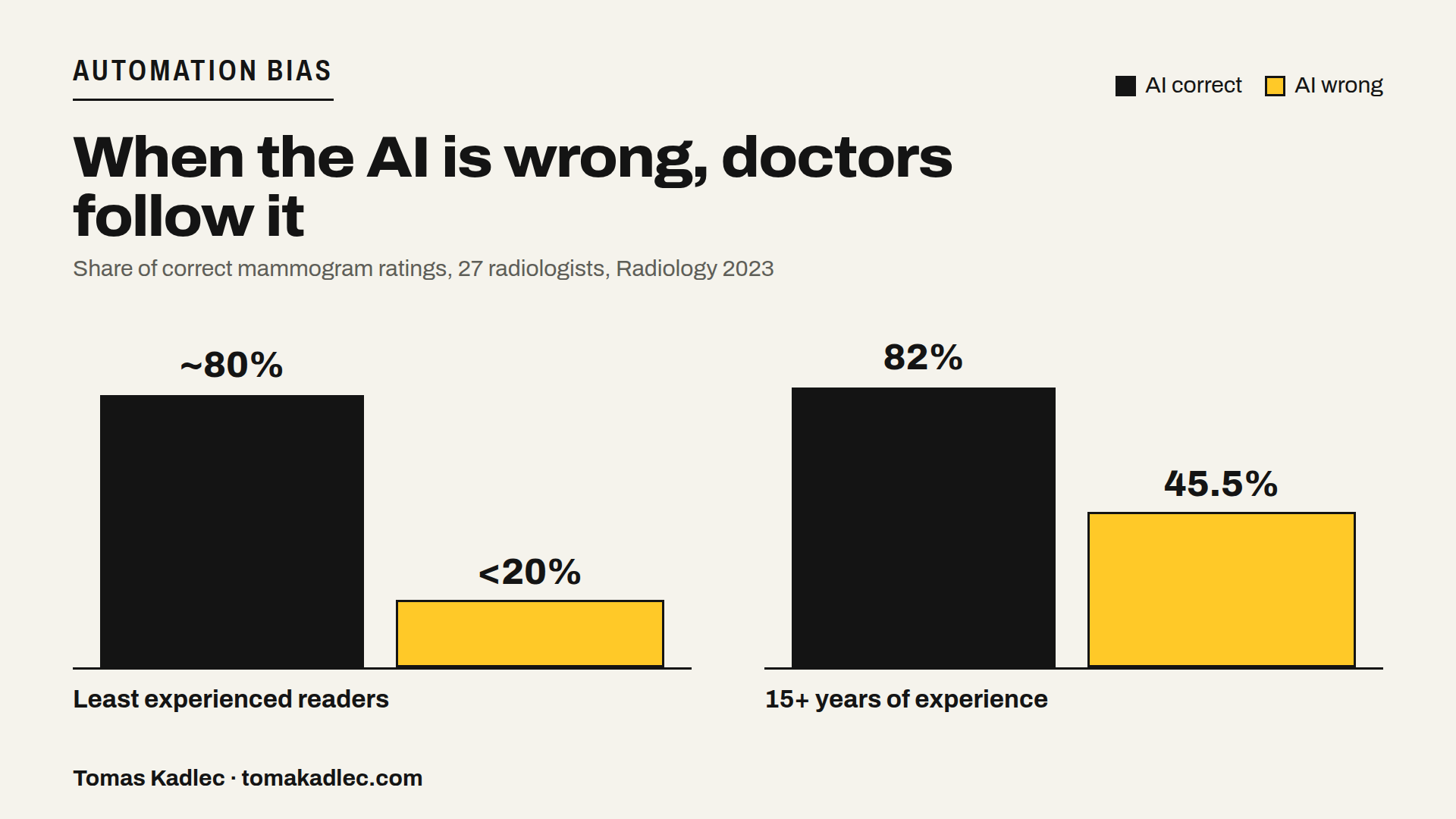
- Doctors follow wrong AI advice. In a 2023 study in the journal Radiology, 27 radiologists read mammograms with an AI assistant. When the AI suggested a wrong category on purpose, the accuracy of the least experienced readers fell from almost 80% to under 20%. The most experienced ones, with 15+ years, fell from 82% to 45.5%.
- Explanations make it worse, not better. A 2024 Harvard Business School experiment found reviewers aligned with AI recommendations 19 percentage points more often than a control group. When the AI added a written rationale, deference went up by another 5 points.
- The skill goes away. McGill University researchers (Scientific Reports, 2020) found that people with more GPS use had worse spatial memory when they had to navigate alone, and the decline grew with use over three years.
So the reviewer is not a wall. The reviewer is a person with a quota, a full inbox and a model that is right most of the time.
Volume kills review
The second problem is simple maths. AI can generate decisions faster than any person can read them.
If an agent drafts 200 customer replies a day and each needs 40 seconds of real reading, that is over two hours of focused review. Nobody gets two hours. So review time goes down, the approval rate goes up, and on paper you still have "human oversight".
Even the EU AI Act knows this. Article 14 on human oversight asks that the people overseeing a high-risk system stay aware of the tendency to rely too much on its output. The law literally names automation bias.
Czech lawyer Petra Stupková (Legitas) said it very directly at AI Restart in Prague on 22 October 2026: human in the loop is often a convenient alibi. People get lazy like with a satnav and after hours of mechanical approvals they click through anything. Her short version: use it or lose it.
What to build instead
I don't think the answer is "no AI". The answer is to stop pretending one approve button is a control. Here is what I use and what I recommend to clients.
1. Decide what never needs a human. Low-risk, reversible work (an internal summary, a draft tag, a first sort of leads) should run without approval. Every approval you remove gives the reviewer more attention for the ones that matter.
2. Put humans only where a mistake is expensive or can't be undone. Money, contracts, anything public under your name, personal data, decisions about people. Write that list down. It is usually short.
3. Make the AI show what it is unsure about. Ask the model for a confidence level and the one thing it would check. Review the low-confidence items first. A reviewer reading 10 risky items beats a reviewer skimming 200.
4. Plant mistakes on purpose. Security teams send fake phishing e-mails to staff. Do the same with AI review. Every week put a few known-wrong outputs into the queue and measure how many your reviewers catch. That catch rate is your real oversight number, not the approval rate.
5. Watch two numbers. Approval rate and time per review. If approvals climb toward 100% and review time drops to a few seconds, nobody is reading anymore.
6. Rotate and rest. The same person approving the same type of output all day will drift. Short review blocks, different people, a second reviewer for the high-risk list.
A prompt you can copy
Paste this under any AI output that a person will approve:
Before I approve this, list: 1) the 3 claims in the text that could be wrong, 2) how sure you are about each (high / medium / low), 3) what I should check and where. Do not rewrite the text.
It takes 10 seconds and it changes the job of the reviewer from "is this fine?" to "check these three things". That is a question a tired person can still answer.
Summary
Human in the loop works when the human has time, attention and a reason to doubt. Most setups give none of these. Fewer approvals, on the right things, measured with planted errors, is safer than a button on everything.
How do you check that your reviewers actually read what they approve?
If you want to look at your own AI workflows together, book a free 20-minute call on tomakadlec.com.
Sources: Dratsch et al., "Automation Bias in Mammography", Radiology, 2 May 2023 (RSNA press release) · Harvard Business School study of 228 evaluators, 2024, as summarised by Tian Pan, "The HITL Rubber Stamp Problem", 15 April 2026 · Dahmani and Bohbot, "Habitual use of GPS negatively impacts spatial memory during self-guided navigation", Scientific Reports, 14 April 2020 · EU AI Act, Regulation (EU) 2024/1689, Article 14 · AI Restart 2026 report, Digichef, 30 October 2026.