73% don't judge their AI agents on sales
73% of B2C marketers with AI agents do not measure them on sales. How to score a chat or voice agent like a sales rep and feed the results back to your ads.
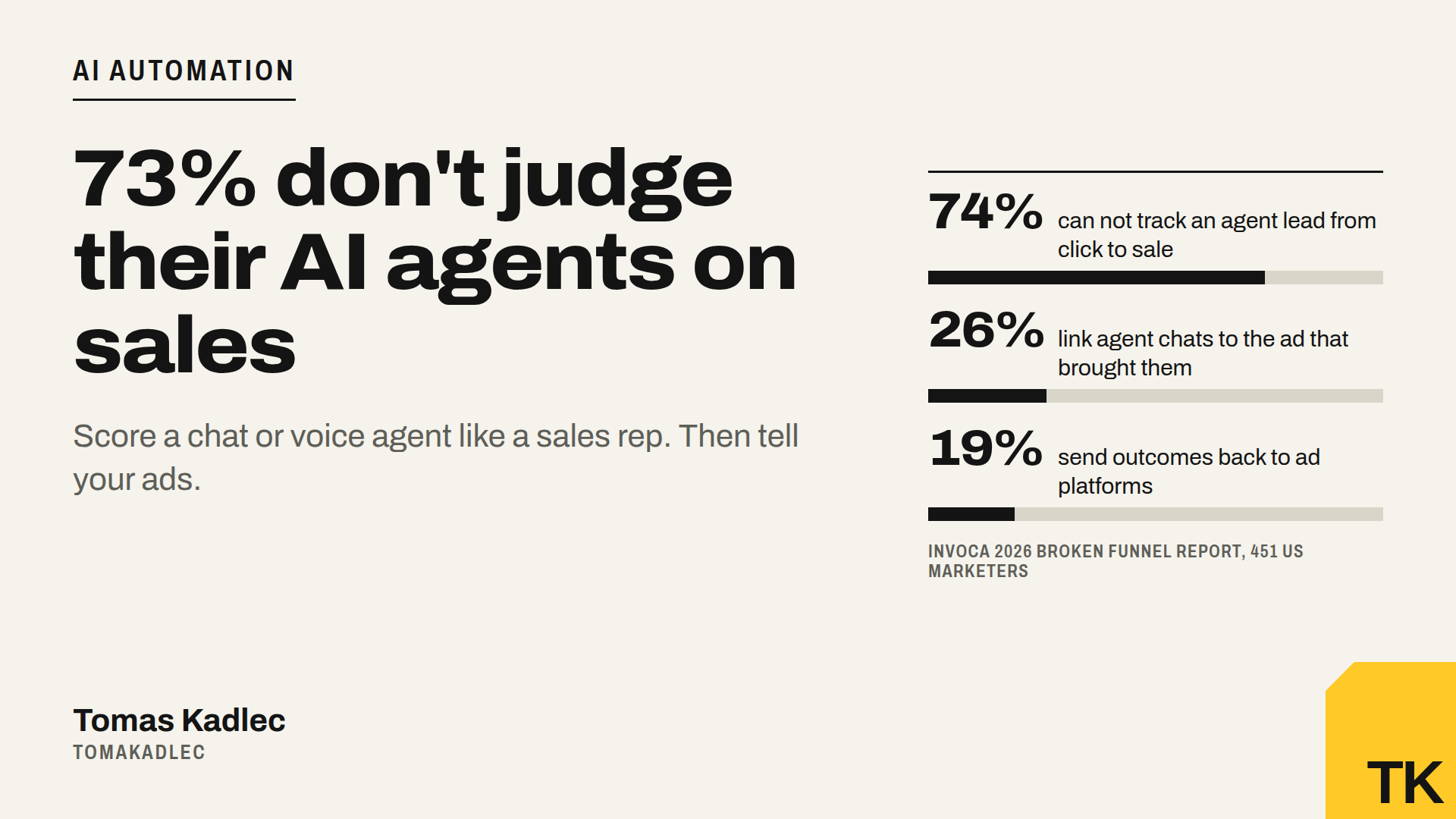
73% of B2C marketers who use AI agents do not measure them on sales.
That is from Invoca's 2026 Broken Funnel Report, published on 10 November. The research firm Gather asked 451 US marketing leaders in automotive, healthcare, home services, financial services and telecom, between 14 September and 5 October 2026. Only 27% use revenue, bookings or conversion rate as the main number for their agents.
Seven in ten of these brands already have AI agents live or in a pilot. So this is not a future problem.
A few more numbers from the same report:
- 74% can not fully track a lead handled by an agent from the first click to the sale
- 26% can connect agent conversations to the campaign or ad that brought the person
- 19% reliably send the outcome of conversations back to their ad platforms
- 1 in 4 lose 20% or more of inbound leads to slow or missed replies
Invoca's CEO Gregg Johnson said it well: "Too many consumer brands measure their AI agents like a help desk and expect them to perform like a sales team."
My take: an agent that answers chats or calls from your ads is doing sales work. Judge it like a sales rep. And send the result back to Google and Meta, or they keep buying you conversations instead of customers.
Help desk numbers vs sales numbers
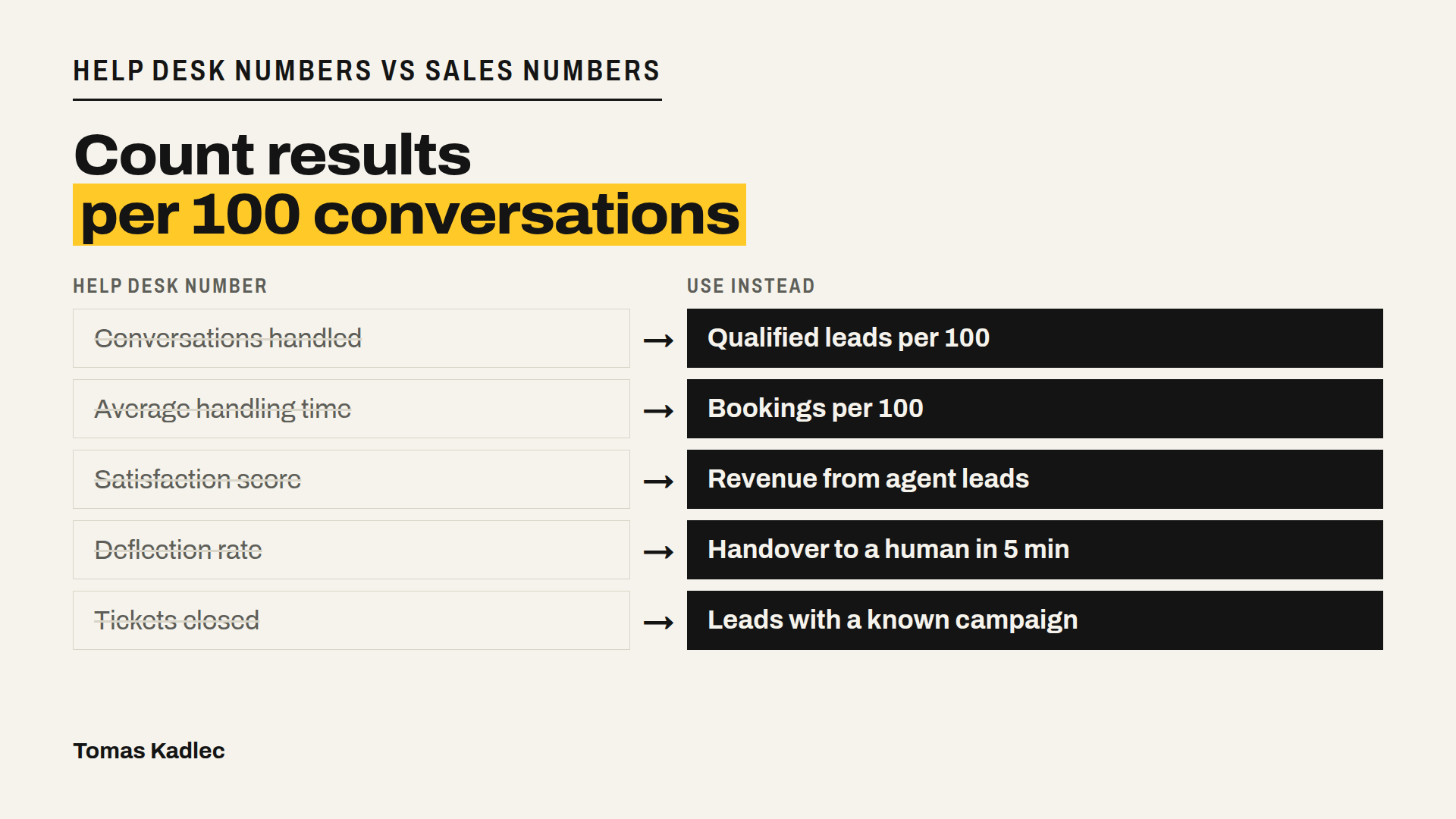
Most agent dashboards show help desk numbers. They look good and say almost nothing about money.
| Help desk number | Sales number to use instead |
|---|---|
| Conversations handled | Qualified leads per 100 conversations |
| Average handling time | Meetings or bookings per 100 conversations |
| Satisfaction score | Revenue from agent-handled leads |
| Deflection rate | Handover to a human within 5 minutes |
| Tickets closed | Leads with a known source campaign |
Connect it in 4 steps
1. Keep the source with the conversation.
When a visitor opens the chat or calls, store the click ID and UTM parameters of their visit (gclid, fbclid, campaign) with the conversation. Most chat tools can read them from the page as hidden fields. Without this, step 3 is not possible. This is the 26% problem.
2. Make the agent write a clear outcome.
Not only a transcript. One field in the CRM with one of a few values, plus a short reason. You can add an instruction like this to the end of your agent's prompt:
When the conversation ends, write a short summary for the CRM with four fields. Outcome: booked, qualified, not a fit, support question or no answer. Reason: max 15 words. Next step: what a human should do, or nothing. Value: the budget or order size if the person said one, otherwise empty. Do not guess values.
3. Send outcomes back to your ads.
Upload qualified and booked leads, with value, as conversions: offline conversion import or enhanced conversions for leads in Google Ads, the Conversions API in Meta. Then the bidding learns which ads bring buyers, not which ads bring chats. Only 19% do this today.
4. Look at one weekly scorecard.
Qualified leads, bookings and revenue per 100 conversations, split by campaign. Plus the share of conversations handed to a human within 5 minutes. If the agent is good at talking and bad at booking, you will see it in the first week.
What not to automate
Prices, discounts and promises stay with a human. The agent can collect the facts and book the call. And do not punish the agent for saying "this is not for you". A clean no is a good outcome. It saves your sales team an hour.
Short summary
Most brands already run AI agents and measure them like a help desk. Measure them like sales: keep the source of every conversation, let the agent write a clear outcome, send qualified and booked leads back to Google Ads and Meta, and read one scorecard per week.
If you want help to connect your agent, CRM and ads, book a free 20-min call on tomakadlec.com.
What is the main number you use for your AI agent today?
Sources: Invoca, 2026 Broken Funnel Report, survey by Gather of 451 US B2C marketing leaders (manager level or above, companies with 100+ employees), fielded 14 September to 5 October 2026, press release 10 November 2026 via PR Newswire (vendor survey).