1 in 5 online orders comes back. Ask AI why
US shoppers return 19.3% of what they buy online. Let an AI read your return reasons and reviews and tell you which product page to fix first.
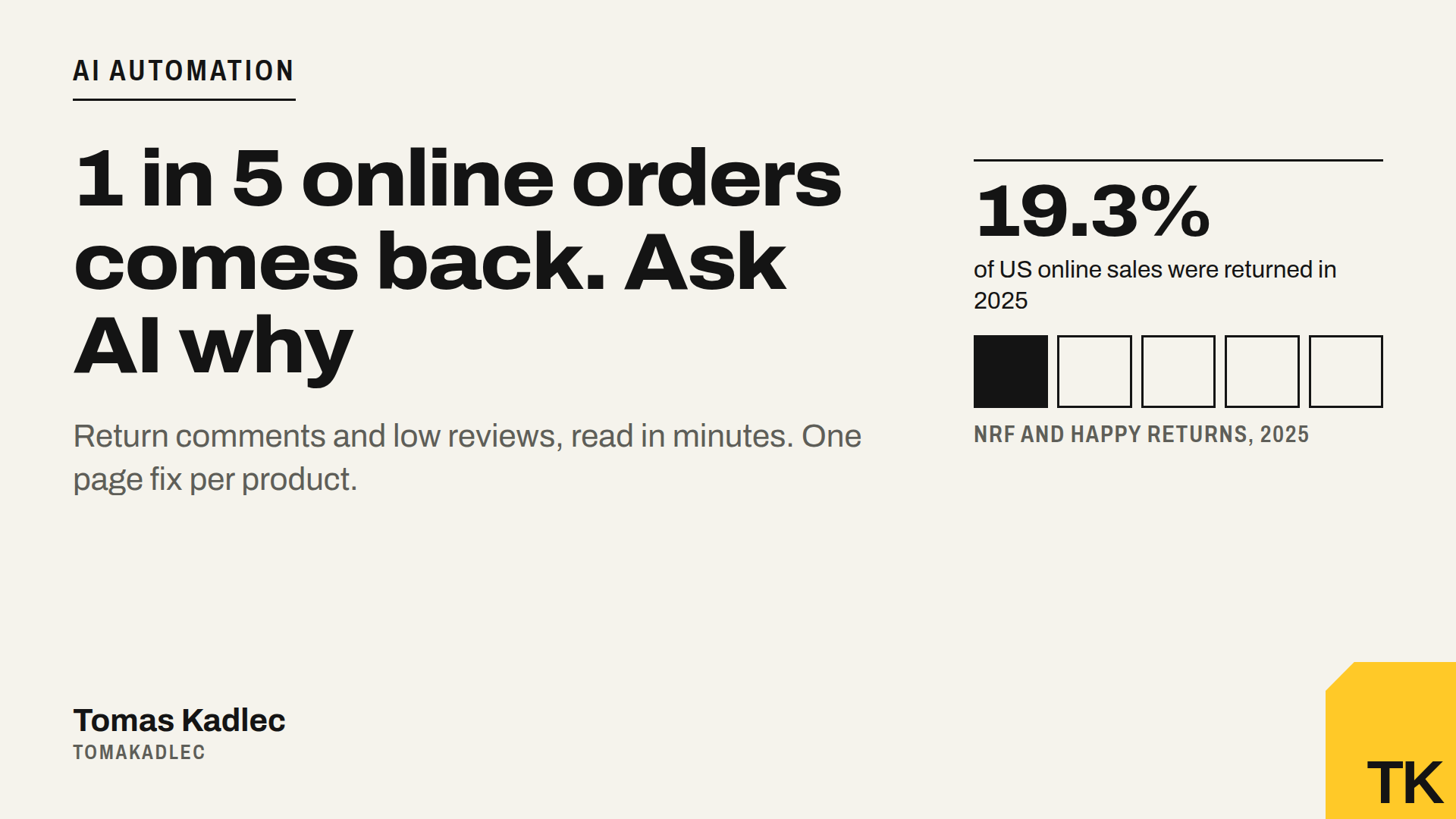
US shoppers return 19.3% of what they buy online. That is almost 1 in 5 orders, from the NRF and Happy Returns report for 2025. For the holidays, retailers expect 17% of sales to come back.
And 71% of shoppers say they are less likely to buy again after a bad return experience.
The reasons are already in your shop admin. Every return has a reason code, many have a comment. Nobody reads 500 comments. An AI reads them in two minutes.
My take: this is one of the best first AI jobs for an e-shop. The data is yours, the output is a short list, and every fix is on a product page you control.
What the AI does
Input, three exports from the last 90 days:
- Returns: product, variant, reason code, the customer's free-text comment.
- Reviews: only 1 to 3 stars.
- Product page text of the top 20 returned products (title, description, size or spec part).
Output: for each product, the top 3 reasons, two real quotes as proof, and one concrete fix on the product page.
The prompt
Copy it into ChatGPT or Claude together with the three files:
I attach three files from my e-shop for the last 90 days: returns with reason codes and comments, 1 to 3 star reviews, and the product page texts. For the 20 products with the most returns: group the reasons into at most 3 patterns per product, count each pattern, and quote two real comments as proof. Then compare each pattern with the product page text and say what the page promises or does not say. Give one concrete change of the page per product. If a pattern is about shipping or packaging, not the page, say so. Do not invent numbers. Return one table sorted by number of returns.
What you usually find
These are typical patterns, not data from one shop:
| Pattern in comments | What the page usually misses | Fix |
|---|---|---|
| "Runs small" | Size advice only in a picture | Size note and measurements as text near the button |
| "Colour is different" | Studio photos only | One daylight photo and the exact colour name |
| "Not what I expected" | Key spec hidden in a tab | Main spec in the first two lines |
| "Arrived too late" | Vague delivery promise | Real delivery date as text |
| "Damaged" | Nothing, it is packaging | Send to the warehouse, not to marketing |
4 rules that keep it clean
- Remove personal data first. Names, e-mails, addresses and order numbers out of the export before it goes to any AI tool. Comments are enough.
- A human decides. The AI suggests the fix, you or the product owner approve the new text.
- Measure per product. Note the return rate of each fixed product today. Check again after 60 days.
- Same export every month. Then a new pattern shows up fast, for example a bad batch from a supplier.
Do it this week
Black Friday is on 27 November. If you fix the pages of your 5 most returned products before that, you fix them for your biggest week. Then run the same prompt again in January, on the holiday returns.
If you use AI to rewrite the product texts, check them before publishing. AI leaves traces in text, and customers notice.
Summary
Almost 1 in 5 online orders comes back, and the reasons sit unread in your shop admin. An AI can read 90 days of return comments and low reviews in minutes and tell you which product page promises something it does not deliver. You fix 5 pages, a human approves every change, and you measure the return rate after 60 days.
Before you publish AI-written product texts, run the free AI trace check. How I run agents with approvals on my own brand is in the social media agent playbook. If you want this set up as a monthly workflow for your shop, that is the AI Marketing Workflow Sprint. Or book a free 20-minute call.
What is the most common return reason in your shop?
Sources: NRF, Consumers expected to return nearly $850 billion in merchandise in 2025, press release 15 October 2025 (2025 Retail Returns Landscape by NRF and Happy Returns, US data).