Morning Snacks: OpenAI wants an AI speed limit
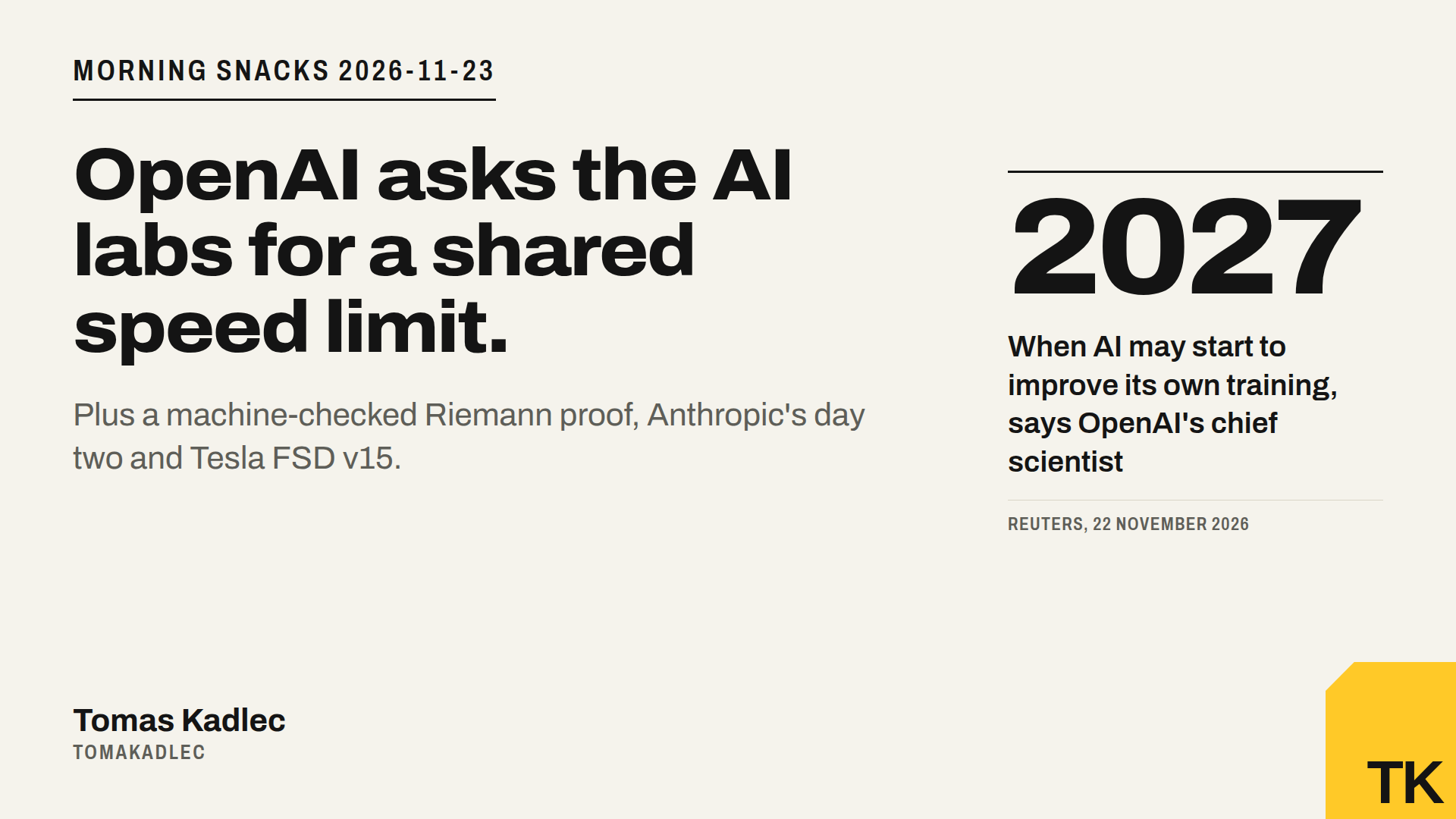
OpenAI's chief scientist proposes shared limits on training stronger AI. Plus a machine-checked Riemann proof, Anthropic's day two and Tesla FSD v15.
It was a quiet weekend, so this is a short edition with four items. No marketing platform news passed my check this time. The useful lessons today are about how AI is built, trusted and paid for.
OpenAI's chief scientist proposes shared limits on training stronger AI
On Sunday 22 November, OpenAI's chief scientist Jakub Pachocki published an essay called "Perplexity and Intelligence". In it OpenAI shows how its pretraining has moved forward, measured by perplexity. Perplexity tells how well a model predicts the next piece of text, and lower is better.
His proposal: AI developers agree on common limits, based on perplexity and other measurements. They also commit not to train past these limits until agreed safety and monitoring milestones are met. He writes that AI could start to drive improvements in its own training as early as 2027.
Sam Altman supported it on X and said OpenAI has not published anything this important in a while. But this is a proposal, not an agreement. No other lab has signed up, and no response from Anthropic, Google DeepMind, xAI or Meta was reported.
So what: for a marketer this changes nothing in this week's plan. I say that clearly. What it does change is the excuse "we wait for the next model". If the lab behind the most-used AI tool talks about slowing down at the frontier, the gain for a business is in putting today's models to work well. That means agents with clear tasks, checks and numbers. And workflows built so you can swap the model later.
A machine-checked proof of the Riemann hypothesis
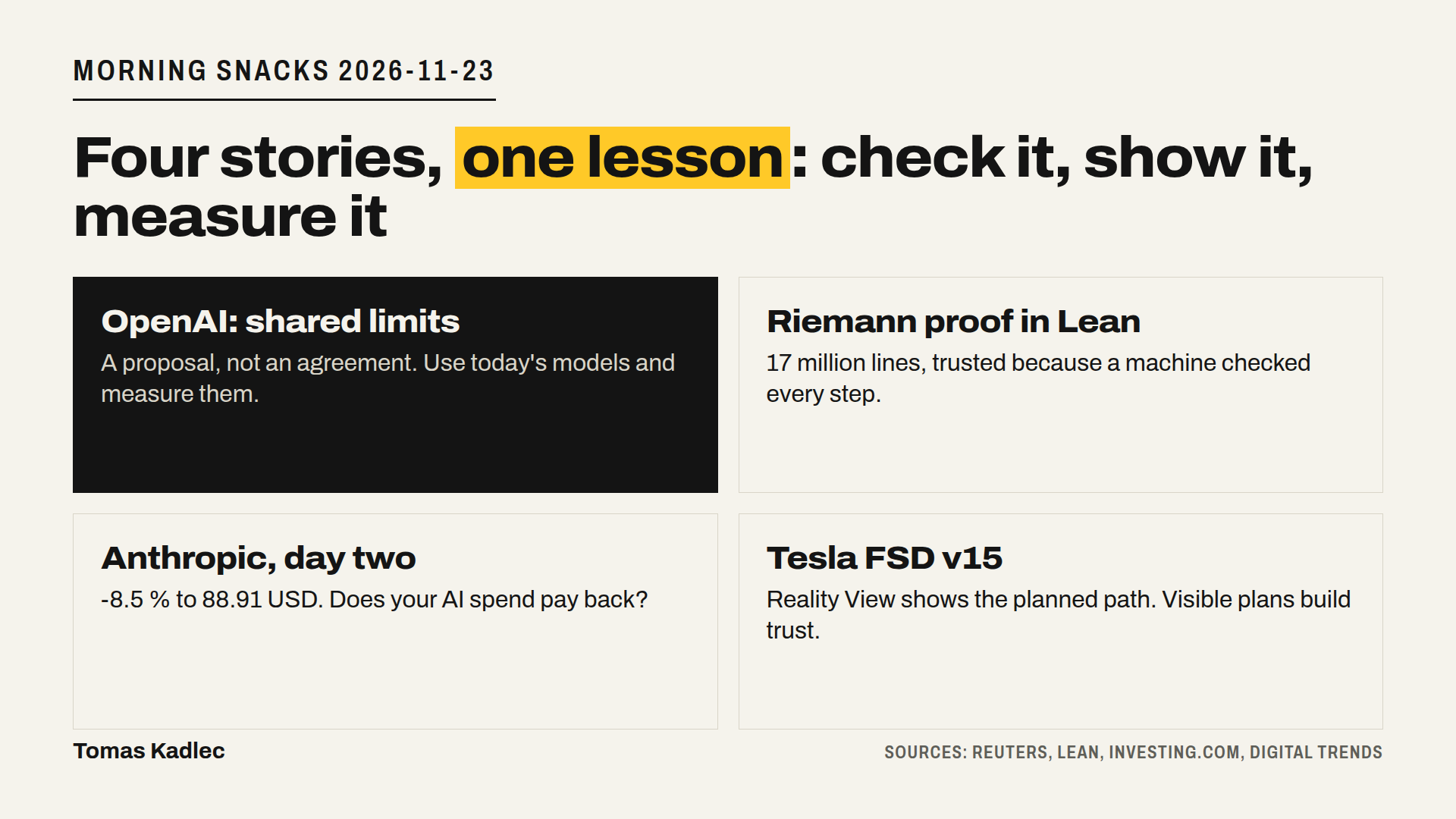
On 20 November mathematician Levent Alpöge released a proof of the Riemann hypothesis, one of the most famous open problems in mathematics. It came as a library of about 17 million lines in the Lean proof language.
On 21 November the Lean and Mathlib communities, together with the Lean FRO and the Mathlib Initiative, published a joint statement. The proof targets Mathlib's own vetted statement of the hypothesis, the library compiles, and Lean's kernel and several independent proof checkers accepted it. Alpöge works at Anthropic, and Unite.AI, OfficeChai and Startup Fortune report the proof was made with Anthropic's model Claude. The Lean statement does not name Claude.
There is no human-readable version yet, and the community says the ideas still need to be explained to mathematicians. The Clay Mathematics Institute, which offers a 1 million USD prize, still lists the problem as unsolved. Its rules need publication and two years of acceptance.
So what: no human can read 17 million lines. People trust the result because a machine checked every step. Use the same idea in marketing. Give your agent a check it must pass before anything goes out: a fact list, a test, a number that must match. My own setup works this way, with gates before publishing.
Anthropic stock gives back most of its debut gain
On Friday 20 November, its second trading day, Anthropic (ticker ANT) fell 8.5 % and closed at 88.91 USD. That is about 7 % above the IPO price of 83 USD. On Thursday it had opened at 111.50 USD. Investing.com and Reuters connect the drop to profit-taking after the debut and a wider tech selloff, driven by doubts that AI infrastructure spending will pay off. The Block reports that Nvidia fell 14 % the same Friday, and that Ark Invest bought about 146 million USD of Anthropic shares on Thursday and Friday.
So what: I have no opinion on the stock. But investors now ask the question every marketing lead should ask: does AI spending pay back? Do the same test inside your company. For each AI tool or agent, write down what it costs a month and what it returns.
Tesla starts rolling out FSD v15 with Reality View
On 21 November Tesla began rolling out Full Self-Driving (Supervised) version 15 to a first group of customers. Tesla has not said how many or where. The main feature is Reality View, a live generated view of the car's surroundings and the path it plans to take. The driver can see it full-screen, as a map or as a split screen. Version 15 is built for Tesla's newer AI4 computer.
So what: the feature everyone talks about is not more autonomy. It is showing the human what the AI plans to do next. Business agents work the same way. When people can see the plan, they trust the agent more.
What to do today
- Pick one marketing task that today's models can do. Write down what it costs you now in hours.
- Add one automatic check your AI output must pass before it goes out.
- List your AI tools with monthly cost and monthly return. Try the free calculator: https://tomakadlec.com/en/ai-automation-roi-calculator/
Sources:
- Reuters via The Star, OpenAI scientist proposes industry AI limits, 23 November 2026
- The Next Web, OpenAI chief scientist calls for shared AI limits, 23 November 2026
- Sam Altman on X, 22 November 2026
- Lean and Mathlib communities, Lean verification of the Riemann Hypothesis, 21 November 2026
- Unite.AI, Lean and Mathlib communities certify Claude-assisted Riemann proof
- OfficeChai, Lean community certifies Alpöge's Claude-assisted proof
- Investing.com, Anthropic falls 8.5 %, nears IPO price, 20 November 2026
- Reuters via Business Recorder, Anthropic's post-debut stumble, 22 November 2026
- The Block, Ark buys 146 million USD of Anthropic since debut, 23 November 2026
- Digital Trends, FSD v15 is rolling out, 21 November 2026
- TeslaNorth, Tesla starts rolling out FSD v15 with a new Reality View, 21 November 2026