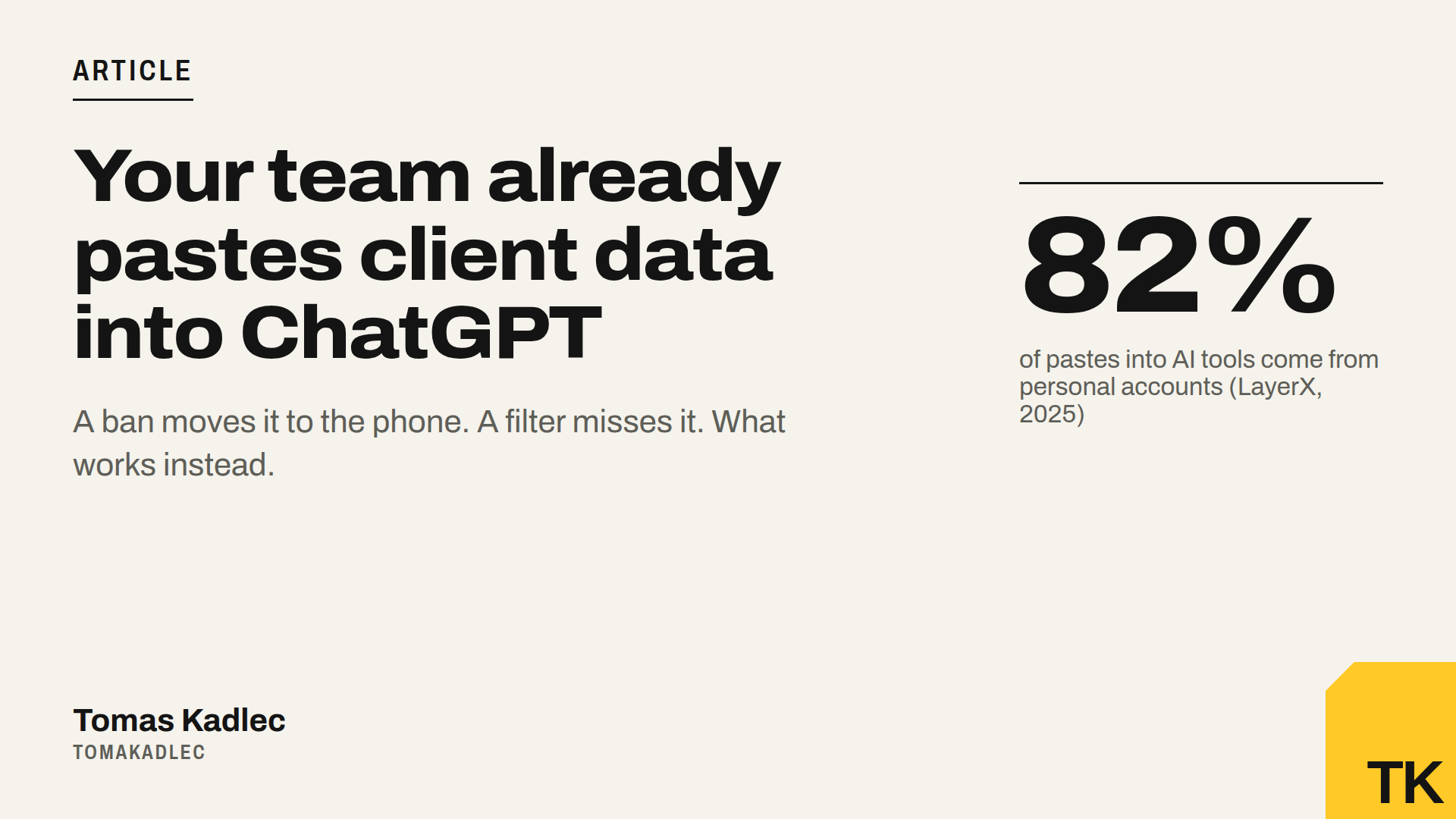
Your team already pastes client data into ChatGPT
Most AI use at work runs on personal accounts nobody controls. A filter or a ban will not stop it. Here is what does, in five steps.
Ask a manager if their team puts client data into ChatGPT. The answer is "no, we have a policy".
Then ask the team.
The account manager pastes a client brief to get a faster proposal. The finance person pastes a spreadsheet to "just check the formulas". The salesperson pastes a call transcript with names, prices and a discount nobody should see. Nobody thinks of it as sending data to America. They think of it as getting work done.
The numbers are not small
LayerX Security measured real browser activity in companies for its 2025 Enterprise AI and SaaS Data Security Report:
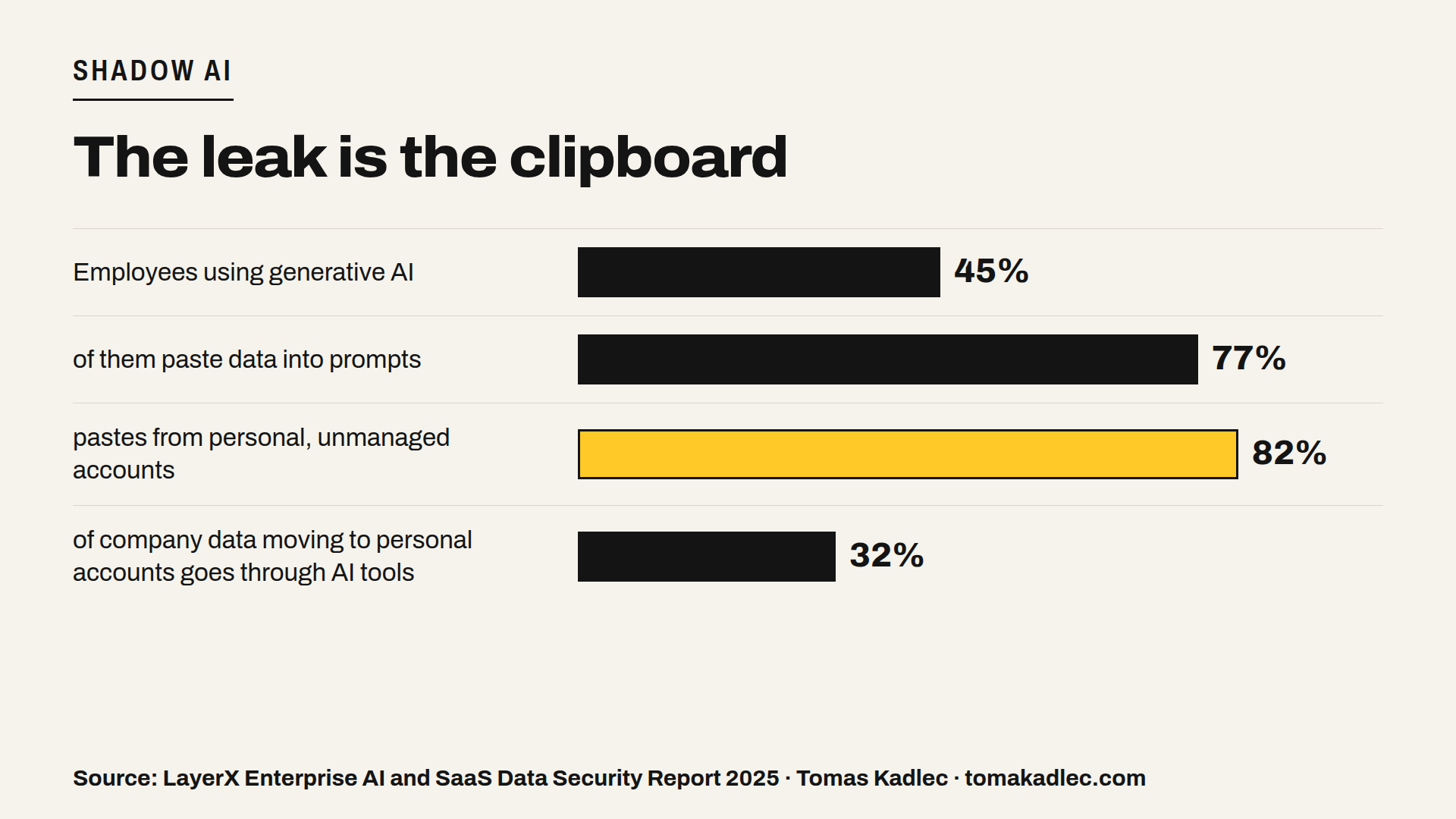
- 45% of enterprise employees already use generative AI tools.
- 77% of those users paste data into prompts.
- 82% of those pastes come from personal, unmanaged accounts, so the company has no visibility at all.
- 40% of files uploaded to AI tools contain personal or payment card data.
- AI tools are now the biggest single channel for company data moving into personal accounts: 32% of it.
Copy and paste is the leak. Classic data loss tools watch files and e-mail attachments. They don't see a clipboard.
And this is not new. In 2023 Samsung engineers pasted internal source code into ChatGPT to fix a bug. Samsung then restricted AI tools for staff. The data was already on someone else's servers.
Why your filter does not help
Many companies did one of two things: they banned ChatGPT, or they bought a tool that blocks the word "confidential" or a card number pattern.
Both miss the real behaviour.
- A ban moves usage to phones. People use the personal app on their own device. Same data, zero visibility.
- A keyword filter catches the obvious. It does not know that "Novák, 12% discount, renewal in March" is a client secret.
- A policy in a PDF is not a control. Czech lawyer Petra Stupková said it at AI Restart 2026: a formal rule banning personal data in AI tools does not work, because everybody works around it. What works is real internal AI governance, with regular reviews of the processes.
Where the data actually goes
On a free or Plus personal account, conversations can be used to improve the models unless the user switches it off in settings. OpenAI's business plans (Business, Enterprise, Edu) and the API are not used for training by default. Enterprise and Edu customers can also choose to store data in Europe.
For personal data of EU people there is one more layer. Transfers to US companies today rest on the EU-US Data Privacy Framework. The EU General Court confirmed it in September 2025, but the case is now on appeal at the EU Court of Justice. The two frameworks before it (Safe Harbor and Privacy Shield) were both cancelled by that court. If your whole AI use depends on that one decision, have a plan B.
None of this matters if the employee is on a private account. Then your company is not even the customer.
What actually works: 5 steps
1. Give people a better tool than their private one. Buy a business plan (ChatGPT Business or Enterprise, Copilot, Claude for Work, Gemini for Workspace) with single sign-on. If the company tool is as good as the private one, most people switch. Usage you can see is usage you can manage.
2. Write a one-page traffic light, not a 20-page policy.
- Green: public info, your own drafts, anonymised data. Any approved tool.
- Orange: internal data, strategy, prices. Only the company account.
- Red: client personal data, health, contracts under NDA, passwords. Not in a chatbot, or only in a setup approved by IT and legal.
3. Teach the "replace before paste" habit. Names become "Client A", amounts become ranges, e-mails disappear. It takes 20 seconds and removes most of the risk.
4. Check what is really happening. Look at which AI domains people visit, which accounts they use, how many personal logins there are. Repeat it every quarter. A rule you never check is a wish.
5. Ask the tired-human question. People paste data when they are under time pressure. If one team pastes the most, ask what work they are trying to speed up and build them a safe workflow for exactly that.
A prompt your team can copy
Before pasting anything sensitive, run the text through this in the company tool:
Rewrite the text below so it contains no names of people or companies, no e-mail addresses, no phone numbers, no exact prices and no contract numbers. Replace them with labels like [CLIENT A] and [PRICE RANGE]. Keep the meaning. Return only the cleaned text.
Summary
Your data is probably already in ChatGPT. Not because people are careless, but because the private tool is faster than the official way. You won't win by banning it. You win by making the safe way the easy way, and by checking that it is used.
Do you know how many of your colleagues use AI on a private account? Would you bet on the number?
If you want to set this up for your team, book a free 20-minute call on tomakadlec.com.
Sources: LayerX Security, Enterprise AI and SaaS Data Security Report 2025 (via eSecurity Planet, TechRadar, 7-10 October 2025) · Samsung memo, reported by Bloomberg, 2 May 2023 · OpenAI, "Introducing data residency in Europe", updated 16 January 2026 · EU General Court, T-553/23 Latombe v Commission, 3 September 2025, appeal pending (DAC Beachcroft, 9 July 2026) · AI Restart 2026 report, Digichef, 30 October 2026.