ChatGPT now links to websites in half of chats
Peec AI found clickable website links in 47.8% of ChatGPT chats, up from about 10% in early October. 63% of linked pages were not cited sources. What to do.
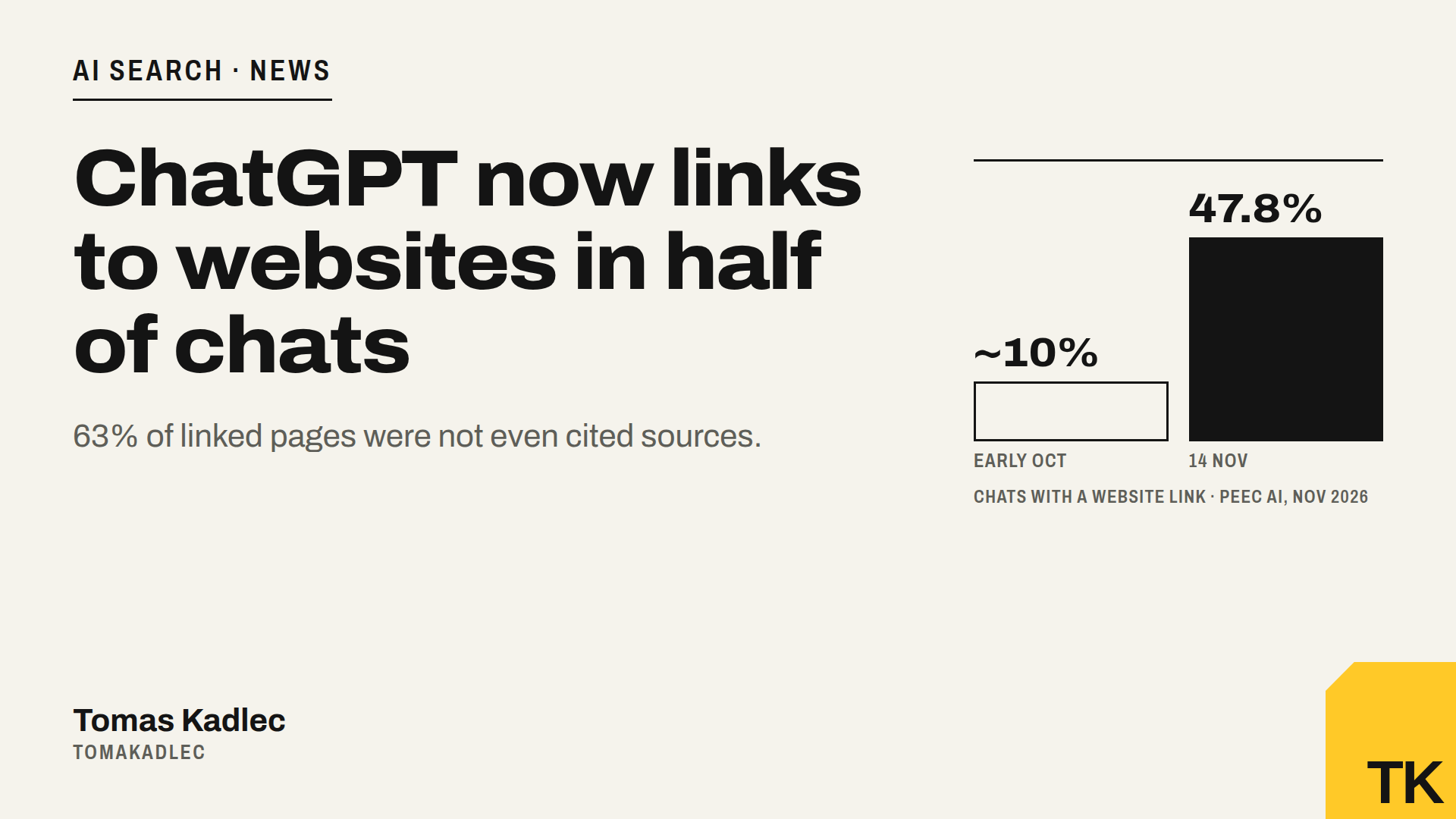
Until early October, about 1 in 10 ChatGPT chats had a clickable link to a website in the answer. On 14 November it was 47.8%.
That is from Peec AI, a company that tracks AI answers. Their researcher David Konitzny posted the data on 16 November. The jump started around 7 October, the day their chart marks as the new default model in ChatGPT.
The second number is more interesting. 63% of the linked pages were not among the sources ChatGPT cited in the same chat. So a site can get a direct link without being a source at all.
My take: for a year we talked about citations. Now there is a second way into the answer, the plain link. And it probably goes to your homepage or a product page, not to your best blog post.
What the data says, and what not
- Chats with at least one link: about 10% until early October, 41% on 9 October, 47.8% on 14 November.
- Chats with 5 or more links: almost 39% of the chats that had links. Average links per linked chat went from about 2 to 4.
- 47% of linked domains were not among the cited domains in the same chat.
What it does not say: sample size, countries, languages, and anything about clicks. Konitzny himself wrote that more links do not automatically mean more traffic. Peec AI sells AI visibility monitoring, and nobody has repeated the study yet. So treat it as a strong signal, not as a fact about your site.
4 things to do this week
- Check your ChatGPT traffic in GA4. Look at sessions with source chatgpt.com, by landing page, last 90 days. If it grew after early October, you see the change on your own site.
- Look at the landing pages, not the blog. Konitzny said the direct links usually go to a homepage or a product page. Open your top 3 landing pages from ChatGPT and ask: does a stranger see in 5 seconds what you sell, the price, and the next step?
- Track links separately from citations. If you test prompts in ChatGPT, write down two things per answer: was your site cited, and was it linked. They are now different numbers.
- Make sure AI can read those pages. A link from ChatGPT to a page that AI crawlers can not read, or that only renders with JavaScript, is a wasted chance.
You can use this prompt on your GA4 export:
I attach a GA4 export of sessions from the source chatgpt.com for the last 90 days, by landing page and week. Show the weekly trend and say if there is a clear change around 7 October 2026. List the 10 landing pages with the most sessions, with their conversion rate next to the site average. Do not invent numbers. If the data is too small to see a trend, say so.
Summary
Peec AI data shows ChatGPT went from links in about 10% of chats to 47.8% in five weeks, and most linked pages were not cited sources. Clicks are not proven yet. But it costs one hour to check your chatgpt.com traffic, fix your top landing pages and make sure AI can read them.
Run the free AI crawler check on your top landing page first. If you want to know where ChatGPT sends people when they ask about your market, that is part of the AI-visibility audit. Or book a free 20-minute call.
Do you already see more visits from ChatGPT since October?
Sources: PPC Land, ChatGPT links to websites in nearly half of chats, up from 10%, Peec AI finds, 16 November 2026 · David Konitzny (Peec AI), LinkedIn post, 16 November 2026.